

This article will cover Top LangGraph Alternatives for Complex AI Workflows. While LangGraph is a great choice for creating AI systems with explicit state graphs, there are other frameworks that excel in areas such as Multi‑Agent Systems, integration with various backends, Retrieval-based and Generative AI Systems, as well as provide automation services through a SaaS model. A careful evaluation of the options available will guide in attaining an optimal balance between the required levels of flexibility and durability for a given production system.
What Is an LangGraph Alternatives for Complex AI Workflows?
Alternatives to LangGraph for building more complex AI apps are frameworks and tools that provide alternatives to LangGraph for state and memory management and provide orchestration, usually by leveraging graphs in other ways. Examples of such tools and frameworks include CrewAI and AutoGen, the OpenAI Agents SDK and the Claude Agent SDK, and Microsoft’s and Google’s commercial offerings.
For interaction management and control, LlamaIndex Workflows and Haystack are good choices. For state management and control, and especially if you need durable persistence, you may want to check out Temporal. Light, SaaS offerings such as Mastra, Coworker AI, and n8n are also choices, especially if you need to manage smaller projects.
Quick Comparison Table
| Framework | Best For | Key Strengths |
|---|---|---|
| CrewAI | Role-based teams | Intuitive role/goals modeling, readable syntax |
| AutoGen | Conversational multi-agent flows | Agents negotiate via dialogue, Microsoft-backed |
| OpenAI Agents SDK | Production agents | Opinionated guardrails, tracing, handoffs |
| Claude Agent SDK | Anthropic ecosystem | Safety-first orchestration, natural language focus |
| Microsoft Semantic Kernel | Enterprise apps | Plugin-based connectors, .NET integration |
| Google ADK | Google ecosystem | Tight GCP integration, scalable orchestration |
| LlamaIndex Workflows | Retrieval-heavy pipelines | Strong RAG, query engines, ingestion |
| Haystack | Search & RAG pipelines | Deepset-backed, modular pipeline framework |
| Temporal | Durable execution | Survives crashes, deterministic replay |
| Mastra | TypeScript teams | Lightweight agent orchestration in JS/TS |
| Coworker AI | Platform-first | Skip framework building, SaaS orchestration |
| n8n | Low-code automation | Visual workflow builder, integrations |
1. CrewAI
CrewAI launched in 2023 to help create complex distributed multi-agent systems. It is free and open-source, with premium enterprise services. Straightforward Python application makes cloud deployments simple. Roles determine how agents interact with the environment, and task pipelines. Agents interact with contexts, which house state and memory.

This allows agents to reference earlier interactions. Examples of workflow simulations integrated with CrewAI show its potential in integrating multiple interacting agents. Overall, CrewAI shows potential in creating interactive software agents that assist humans in completing tasks.
Key capabilities: Role-based, team-based organization; memory.
Best use cases: Work involving teams.
Limitations: State management; enterprise integration; connectors.
Strengths: Simulating human team behavior.
Weaknesses: Reliability.
| Feature | Details |
|---|---|
| Founded | 2023 |
| Pricing | Open‑source, free; enterprise support optional |
| Deployment | Python, cloud or local |
| Control Flow | Role‑based orchestration |
| State Handling | Context objects |
| Memory | Persistent agent memory |
| Scalability | Supports multi‑agent teams |
| Integration | Works with LangChain, APIs |
| Reliability | Good for collaborative tasks |
| Customization | Flexible role definitions |
| Ecosystem | Growing open‑source community |
| Best Use | Multi‑agent collaboration |
2. AutoGen
AutoGen was created in 2023 by Microsoft Research. It is open source and has a free version with an enterprise version tailored to specific needs. It uses the concept of inter-agent communication to define the control flow and work processes within the system. State and memory are defined by the conversation history.

Negotiation and interaction among the agents to define and complete their tasks are of prime importance in systems powered by this technology. It is best suited for systems requiring dozens or hundreds of agents that must interact in a flexible and structured manner.
Key Capabilities: Adaptive workflow, conversation memory
Best Use Cases: Iterative problem solving, negotiation
Limitations: Enterprise tooling, control flow
Strength: Inter-agent communication
Weakness: Reliability
| Feature | Details |
|---|---|
| Founded | 2023 (Microsoft Research) |
| Pricing | Free, open‑source |
| Deployment | Python, cloud/local |
| Control Flow | Dialogue‑centric |
| State Handling | Conversation history |
| Memory | Persistent conversational memory |
| Scalability | Multi‑agent negotiation |
| Integration | Works with APIs, LLMs |
| Reliability | Adaptive workflows |
| Customization | Flexible agent roles |
| Ecosystem | Microsoft‑backed |
| Best Use | Negotiation workflows |
3. OpenAI Agents SDK
OpenAI Agents SDK was released in 2024 by OpenAI. It provides developers the means to build different types of AI agents and charging users based on the cost of utilizing OpenAI’s APIs. It mainly focuses on developing cloud applications with software development kits in Python and JavaScript.
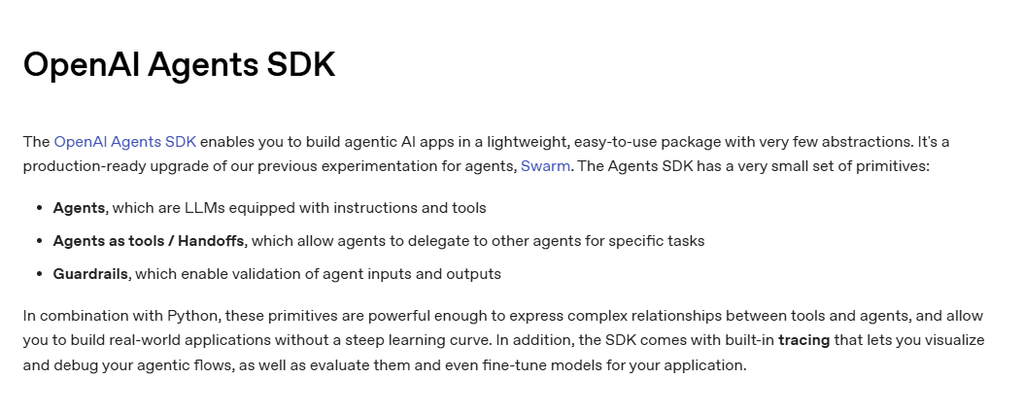
Control flow utilizes directive-based approaches with embedded guards, tracing, and error handling. State and memory are modeled with respect to guardrails within structured contexts. Persistent storage is available for enterprise needs. The SDK builds in safeties and reliability to enable tracing and auditing of compliance.
Key Capabilities: Guardrails, persistent memory
Best Use Cases: Compliance agents, production orchestration
Limitations: Pricing, flexibility
Strength: Reliability
Weakness: Experimental use cases
| Feature | Details |
|---|---|
| Founded | 2024 |
| Pricing | Usage‑based (OpenAI API) |
| Deployment | Cloud‑first, Python/JS |
| Control Flow | Opinionated guardrails |
| State Handling | Structured contexts |
| Memory | Persistent storage options |
| Scalability | Enterprise‑ready |
| Integration | OpenAI ecosystem |
| Reliability | Strong tracing/error handling |
| Customization | Limited but safe |
| Ecosystem | Large developer base |
| Best Use | Production agents |
4. Claude Agent SDK
The Claude Agent SDK was released by Anthropic in 2024 and focuses on deploying AI safely within a specified realm. It is free but charges for Claude API usage.

It is available for cloud deployment with SDKs for Python and Node.js. Similar to the Claude API, the Claude Agent SDK allows users to structure workflows with script-like commands to define conversation flows.
State and memory are modeled with persistent contexts, and the SDK emphasizes ethical guardrails. The Claude Agent SDK is well-suited for command and control interactions with natural language.
Key Capabilities: Conversational workplace automation, persistent memory
Best Use Cases: AI orchestration, workflow automation
Limitations: Pricing, control flow
Strength: Ethics
Weakness: Technical limitations
| Feature | Details |
|---|---|
| Founded | 2024 (Anthropic) |
| Pricing | Usage‑based (Claude API) |
| Deployment | Cloud, Python/Node.js |
| Control Flow | Natural language workflows |
| State Handling | Persistent contexts |
| Memory | Ethical guardrails |
| Scalability | Enterprise‑ready |
| Integration | Anthropic ecosystem |
| Reliability | Safety‑first |
| Customization | Conversational definitions |
| Ecosystem | Growing adoption |
| Best Use | Safe orchestration |
5. Microsoft Semantic Kernel
The Microsoft Semantic Kernel was released in 2023 and focuses on deploying AI within plugin architectures. It is free but charges for enterprise services.

It supports plugin architectures in .NET, Python and Java. State and memory are modeled with semantic stores, enabling long term memory within AI. The Microsoft Semantic Kernel is best suited for integrating AI within enterprise applications and peripheral services.
Key Capabilities: Enterprise integrations, memory
Best Use Cases: Enterprise AI apps
Limitations: Vendor lock-in, Microsoft integrations
Strength: Enterprise integrations
Weakness: Complexity, debugging
| Feature | Details |
|---|---|
| Founded | 2023 |
| Pricing | Free, open‑source |
| Deployment | .NET, Python, Java |
| Control Flow | Plugin‑based chaining |
| State Handling | Semantic memory stores |
| Memory | Long‑term recall |
| Scalability | Enterprise integration |
| Integration | Microsoft ecosystem |
| Reliability | Strong enterprise support |
| Customization | Flexible skill chaining |
| Ecosystem | Large developer base |
| Best Use | Enterprise AI apps |
6. Google ADK
Released in 2024, the Google AI Development Kit (ADK) is designed to work with Google Cloud Platform (GCP). Pricing is not announced, but expected to be Google Cloud Service usage-based. Currently cloud-deployed, SDKs are provided for Python and Java.

The customer can scale the AI resources based on their control flow needs, using Google’s tools for orchestration. Large datasets can be saved using memory persistence with BigQuery and Vermex AI. ADK is initially targeted at customers who have previously standardized with Google Cloud Platform.
| Feature | Details |
|---|---|
| Founded | 2024 |
| Pricing | Usage‑based (GCP services) |
| Deployment | Cloud‑native |
| Control Flow | Scalable orchestration |
| State Handling | Vertex AI, BigQuery |
| Memory | Persistent large‑scale recall |
| Scalability | Enterprise‑grade |
| Integration | Google Cloud ecosystem |
| Reliability | Strong cloud support |
| Customization | Limited to GCP |
| Ecosystem | Google developer base |
| Best Use | Cloud enterprises |
7. LlamaIndex Workflows
The company LlamaIndex launched in 2022 and debuted Workflows in 2024 as a feature of their retrieval-augmented generation (RAG) system. RAG systems rely on large language models (LLM) and LlamaIndex Workflows are open-source and free.

LlamaIndex uses vector databases for state management, allowing it to retain context for a given query. LlamaIndex Workflows allow users to develop query pipelines and focus on the control flow. Because Workflows can develop context for a given query pipeline, the system is best used for pipelines that require extensive domain knowledge.
Strengths: Vector databases and retrieval, contextualization and recall.
Best Uses: Knowledge workflows, document and/or data processing.
Limitations: Rigid, retrieval-centric nature, lack of enterprise integration.
Strengths: Retrieval and (re)generation of Answer-Given Knowledge.
Weaknesses: Not well suited for multi-agent orchestration.
| Feature | Details |
|---|---|
| Founded | 2022 |
| Pricing | Free, enterprise support |
| Deployment | Python |
| Control Flow | Retrieval pipelines |
| State Handling | Document stores |
| Memory | Vector databases |
| Scalability | Knowledge pipelines |
| Integration | LangChain, APIs |
| Reliability | Strong RAG |
| Customization | Flexible queries |
| Ecosystem | Active open‑source |
| Best Use | Knowledge workflows |
8. Haystack
Haystack was created by Deepset in 2020 and released as open-source software. Deepset charges for enterprise use of their software. Similar to LlamaIndex, Haystack relies on state and contextual management for retrieval systems.
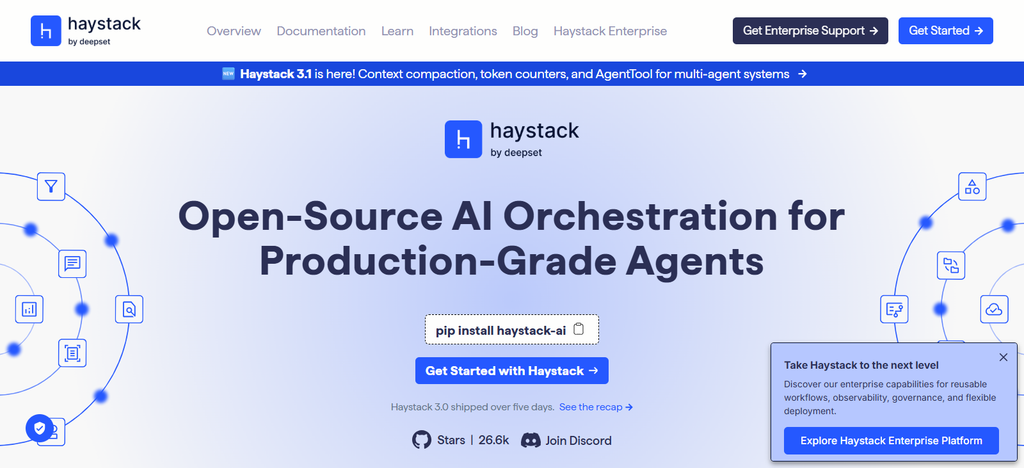
Unlike LlamaIndex, Haystack employs a modular control flow and thus allows developers to integrate more complex systems. Haystack offers a contextual and retrieval storage framework for state management and is best used for software systems that integrate search functionalities.
Key Capabilities: Modular pipelines, document stores, contextual recall.
Best Use Cases: Search workflows, RAG pipelines, enterprise knowledge bases.
Limitations: Limited orchestration features, less durable state handling, debugging complexity.
Strength: Strong retrieval/search.
Weakness: Not optimized for multi‑agent orchestration.
| Feature | Details |
|---|---|
| Founded | 2020 (Deepset) |
| Pricing | Free, enterprise tiers |
| Deployment | Python |
| Control Flow | Modular pipelines |
| State Handling | Document stores |
| Memory | Contextual recall |
| Scalability | Search pipelines |
| Integration | APIs, databases |
| Reliability | Strong retrieval |
| Customization | Component chaining |
| Ecosystem | Active community |
| Best Use | RAG/search workflows |
9. Temporal
Temporal launched in 2019 with enterprise cloud offering and open-source options. It provides deployment options in multiple programming languages. Temporal offers deterministic control flow to ensure workflow can be replayed in its entirety.
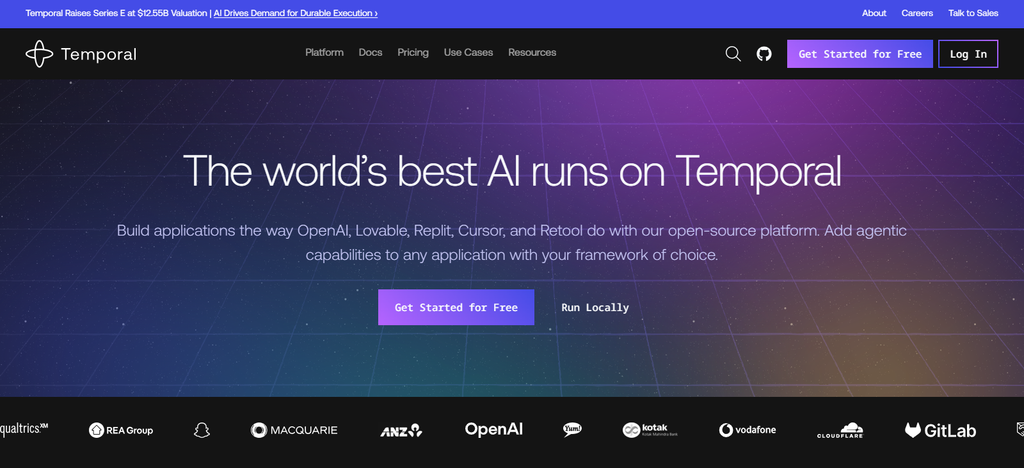
It provides state and memory persistence to ensure durability and continuous-ness in workflow. This allows for long-running workflow. Temporal is not focused on A.I. but rather on reliability and provides that reliability best of all workflow orchestration engines.
Key Capabilities: Deterministic replay, durable workflows, crash resistance.
Best Use Cases: Mission‑critical orchestration, long‑running workflows, enterprise reliability.
Limitations: Not AI‑specific, complex setup, requires developer expertise.
Strength: Unmatched durability.
Weakness: Less AI‑native orchestration features.
| Feature | Details |
|---|---|
| Founded | 2019 |
| Pricing | Free, enterprise cloud |
| Deployment | Go, Java, Python |
| Control Flow | Deterministic replay |
| State Handling | Durable workflows |
| Memory | Crash‑resistant |
| Scalability | Mission‑critical apps |
| Integration | APIs, microservices |
| Reliability | Unmatched durability |
| Customization | Workflow definitions |
| Ecosystem | Strong enterprise |
| Best Use | Reliable orchestration |
10. Mastra
Mastra was created in 2024 and provides an open-source, type-safe framework for software agent orchestration. Control flow for Mastra is lightweight, allowing for the development of simple pipelines for software agents.

For state and memory, Mastra uses context objects and is therefore limited for larger agent systems. For small agent systems, Mastra offers a framework for software developers quickly and easily.
Key Capabilities: Lightweight pipelines, TypeScript integration, context memory.
Best Use Cases: Web developer workflows, small team orchestration, lightweight agents.
Limitations: Limited persistence, less enterprise support, smaller ecosystem.
Strength: Developer‑friendly simplicity.
Weakness: Not suitable for large‑scale orchestration.
| Feature | Details |
|---|---|
| Founded | 2024 |
| Pricing | Free, enterprise support |
| Deployment | JavaScript/TypeScript |
| Control Flow | Lightweight pipelines |
| State Handling | Context objects |
| Memory | Limited persistence |
| Scalability | Small teams |
| Integration | Web ecosystem |
| Reliability | Lightweight |
| Customization | Developer‑friendly |
| Ecosystem | Growing |
| Best Use | Lightweight orchestration |
11. Coworker AI
Coworker AI provides a software as a service (SaaS) solution for agent orchestration, and was launched in 2025. Coworker charges a subscription for its service and provides different plans for teams and enterprises. Their offering is platform first, therefore, customers do not manage any infrastructure.
With Coworker, control flow is abstract and the service provides agent orchestration. Coworker manages state and memory and provides a solution for fast deployment.
Key Capabilities: SaaS orchestration, platform‑managed workflows, subscription tiers.
Best Use Cases: Fast deployment, team workflows, SaaS‑based orchestration.
Limitations: Limited customization, platform dependency, less developer control.
Strength: Quick setup and deployment.
Weakness: Reduced flexibility for custom workflows.
| Feature | Details |
|---|---|
| Founded | 2025 |
| Pricing | Subscription tiers |
| Deployment | SaaS platform |
| Control Flow | Abstracted orchestration |
| State Handling | Internal management |
| Memory | Limited developer control |
| Scalability | Team/enterprise |
| Integration | SaaS connectors |
| Reliability | Platform‑managed |
| Customization | Limited |
| Ecosystem | SaaS users |
| Best Use | Fast deployment |
12. n8n
Founded in 2019, n8n’s paid offerings are cloud based. Low-code deployment is enhanced by a visual builder for workflows. Control flows are defined by nodes, facilitating drag and drop.

Memory is scoped to workflows, and persistence is limited. Work best for automation requirements where integrations are the major concern and low-code nature of the product is an additional benefit.
Key Capabilities: Low‑code orchestration, visual builder, 300+ connectors.
Best Use Cases: Automation pipelines, integrations, low‑code workflows.
Limitations: Limited persistence, less AI‑specific orchestration, scalability challenges.
Strength: Easy drag‑and‑drop automation.
Weakness: Not ideal for complex AI workflows.
| Feature | Details |
|---|---|
| Founded | 2019 |
| Pricing | Free, cloud tiers |
| Deployment | Low‑code, visual builder |
| Control Flow | Node‑based orchestration |
| State Handling | Workflow contexts |
| Memory | Limited persistence |
| Scalability | Automation pipelines |
| Integration | 300+ connectors |
| Reliability | Good for automation |
| Customization | Drag‑and‑drop |
| Ecosystem | Large open‑source |
| Best Use | Low‑code automation |
How To Choose LangGraph Alternatives for Complex AI Workflows
Workflow Considerations
Determine the extent of collaboration amongst agents in your workflow as well as the presence of retrieval pipelines and durable execution.
Integration Considerations
Adopt an integrated approach by using the Semantic Kernel in conjunction with other services within your ecosystem.
State and Memory Considerations
Consider the means by which each framework handles persistence.
Monetary Considerations
Consider the means by which each framework handles persistence.
Use case Considerations
Consider the means by which each framework handles persistence.
Conclusion
LangGraph is an excellent choice if you are looking for a solution that provides explicit state‑based orchestration. However, there are other options that may be more attractive, depending on your requirements. For example, both CrewAI and AutoGen focus on defining teammate behaviors to enable effective interaction in multi-agent scenarios.
Additionally, the Safety and General Availability of the Agents provided by OpenAI’s Agents SDK and Claude’s Agent SDK cannot be ignored. In the case of Enterprise Integrations, Microsoft and Google provide kits that are similar to their respective semantic kernels. If your focus is on Defining and Retrieving Knowledge, then frameworks like LlamaIndex and Haystack offer powerful solutions.
For ensuring the Persistence of your data, you can look at Temporal. Mastra, Coworker AI and n8n are other frameworks you should look at, especially if you are focused on ease of integration and flexibility.
FAQ
What is LangGraph?
LangGraph is an open‑source Python framework designed for complex AI workflows. It emphasizes explicit state graphs, cycles, and checkpointing, making it ideal for multi‑step orchestration but often verbose compared to newer alternatives.
Which alternatives are best for multi‑agent workflows?
CrewAI and AutoGen are the strongest choices. CrewAI uses role‑based orchestration, while AutoGen enables conversational negotiation between agents. Both excel at collaborative task execution.
Which alternatives are enterprise‑ready?
Microsoft Semantic Kernel and Google ADK integrate tightly with enterprise ecosystems. They support plugin connectors, cloud scalability, and persistent memory, making them ideal for production environments.
Which frameworks focus on retrieval‑augmented generation (RAG)?
LlamaIndex Workflows and Haystack specialize in RAG pipelines. They manage document stores, vector databases, and contextual recall for knowledge‑intensive workflows.