

In this article, I will talk about the Best AI Agents for Insurance Claims Processing that helps insurance companies to automate claim management and improve operational efficiency. These AI-enabled solutions enable the easy execution of critical tasks such as claim intake, document verification, fraud detection, damage assessment and settlement workflows.
With insurance companies seeing more claims coming in, picking the right AI agent is important to cut down on manual work and boost accuracy. I’ll compare their key features, strengths, limitations and best use cases to help you decide.
What Are AI Agents for Insurance Claims Processing?
AI agents for insurance claims processing are intelligent software systems that use artificial intelligence, machine learning, natural language processing, and automation to process different stages of insurance claims. They help insurers automate tasks such as First Notice of Loss (FNOL), document collection, policy verification, fraud detection, damage assessment, claim prioritization and settlement recommendations.
These agents can sift through the sea of claims data, identify missing information, and speed up decisions. Traditional rule-based automation is not the same as advanced AI agents that can understand information, adapt to evolving circumstances, and orchestrate multi-step workflows. But complex claims and final approval decisions may still need human adjuster involvement.
Quick Comparison Table
| AI Agent / Platform | Best For | Key Claims Processing Capability |
|---|---|---|
| Five Sigma (Clive) | End-to-end claims management | AI-powered claim intake, triage, investigation, and workflow automation |
| Sprout.ai | Automated claims assessment | Document processing, coverage verification, and claim decision support |
| Shift Technology (Shift Claims) | Fraud detection and claims decisioning | Fraud identification, claim assessment, prioritization, and investigation support |
| Bevaya (Roots Automation) | Document-heavy claims processing | Intelligent document extraction, data validation, and claims workflow automation |
| Guidewire AI | Enterprise insurance claims | Agentic automation, predictive intelligence, and claims workflow support |
| Duck Creek Technologies AI | Property and casualty claims automation | AI-assisted claims intake, processing, and insurance workflow management |
| Tractable | Vehicle and property damage assessment | Computer vision, image analysis, and automated damage estimation |
| CCC Intelligent Solutions | Auto insurance claims processing | AI-powered vehicle damage estimation, repair analysis, and claims workflows |
| Snapsheet | Digital claims management | Virtual appraisals, claims automation, and digital customer communication |
| Ushur | First Notice of Loss (FNOL) automation | Conversational AI, digital claims intake, and policyholder communication |
1 Five Sigma (Clive)
Clive by Five Sigma is an AI-native claims management platform that automates and orchestrates the claims lifecycle. It’s multi-agent AI that coordinates specialized agents for intake, triage, coverage verification, liability, communications, fraud detection, reserves and settlement.” Clive uses natural language processing, machine learning, predictive analytics and computer vision to read claim data, automate routine tasks and progress claims based on SOPs defined by the insurer.

It enables document management, dynamic scheduling of work, risk assessment, and QA/compliance checks, while preserving human decision points with explainable context. The integration is API-driven, meaning Clive can plug into existing claims systems, consume incoming data and output structured actions, without having to replace the entire core system.
Where it’s strong: Clive helps claims teams with AI-powered automation, intelligent claim handling, workflow coordination and decision support, allowing insurers to reduce the manual tasks in their claims operations.
Where It Is Weaker: Due to its advanced capabilities it may require workflow configuration and integration work. Insurers should consider implementation requirements, customization needs and fit for their existing claims infrastructure.
Best For: Insurance companies looking for an AI-driven claims management solution that automates claim intake, triage, investigation, workflow coordination, and adjuster support.
Must-Have Features
- AI-enabled claims management and automation.
- Automated claims intake and triage.
- Intelligent orchestration of claims workflow.
- Investigation of claims and decision support.
- Integration with insurance systems.
2. Sprout.ai
Sprout.ai is an AI claims-intelligence layer, focused on insurance, that helps carriers automate claims processing and improve fraud detection. The company platform combines document automation, policy checks, real time decision support and fraud analysis to reduce settlement cycle times and manual handling. AI is able to read claim documents in multiple languages and summarize them, pulling out claimant details, incident descriptions, policy numbers and other structured information to help the adjuster.
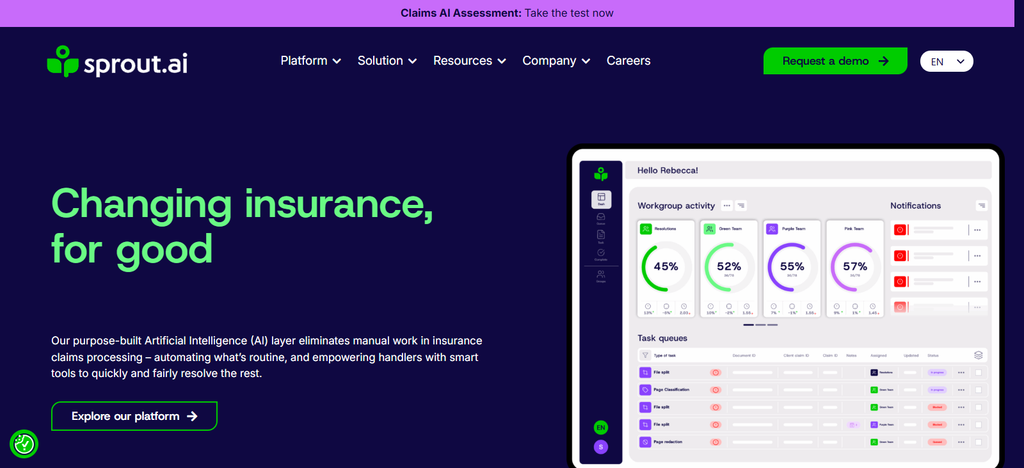
Sprout.ai will process eligible claims on a straight-through basis, with exceptions being flagged for human review. One of its strengths is integration: It provides REST APIs and prebuilt connectors for core platforms like Guidewire, Duck Creek, Majesco, Sapiens, Insurity, EIS, BriteCore, and DXC, allowing insurers to add AI without replacing their existing claims stack.
Where It’s Strong: Sprout.ai is focused on automating insurance claims with intelligent document processing, data extraction, coverage assessment and decision support to help insurers streamline complex claims workflows.
Where It Falls Short: Its success will depend on the quality of the documents, availability of claims data and integration with existing insurance systems. For complex cases, human evaluation and approval might still be required.
Best For: Insurance providers seeking to automate document-heavy claims processing, increasing efficiencies in assessment and reducing manual work across property, casualty and other insurance claims.
Main Features
- Automated claims via AI.
- Smart document processing.
- Automatic data extraction.
- Claims processing and coverage assistance.
- Shift Technology (Shift Claims)
3. Shift Technology (Shift Claims)
Shift Claims is Shift Technology’s agentic-AI claims platform for evaluating, prioritizing, advising on, and automating insurance claims. It brings together FNOL data, notes, documents and communications into a single claim view, and then evaluates coverage, liability, damage, injury, subrogation, litigation exposure and fraud risk.
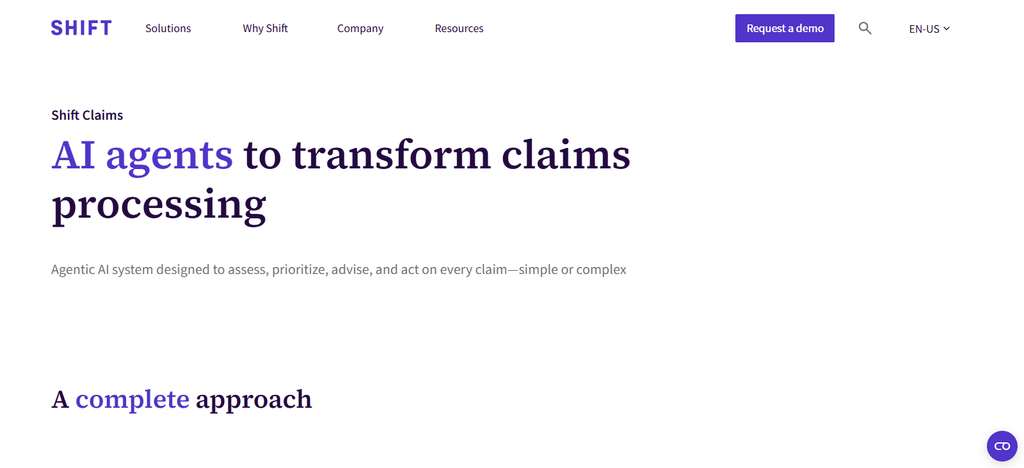
The platform categorizes and scores claims according to complexity, urgency, severity and exposure, routes them to handlers or a STP agent, and automates relevant activities such as communications, service set-up, orders and payments
Generative AI and LLMs can help with document summarization, classification and liability determination. Shift also has fraud-detection tools for SIUs, including cross-carrier data sharing through its IDN. Integration support integrates APIs, MCP and A2A connections to core systems and external orchestration.
What it does well:Shift Technology is dedicated to insurance decision intelligence. It helps insurers to spot suspicious claims, potential fraud, prioritize investigations, and improve claims decisions using advanced AI analytics.
Where it’s not so strong: Its fraud detection and decision support capabilities are not a substitute for all claims management functions. Insurers might require more platforms to handle the entire intake, administration and settlement workflows.
Best For: Property, casualty and other insurers looking for advanced fraud detection, identification of suspicious claims, prioritization of investigations and data-driven claims decision making.
Basic Features
- Claims fraud detection powered by AI.
- Identifying suspicious behavior.
- Automatic risk scoring.
- Prioritizing claims investigation
- AI enabled decision intelligence
4. Bevaya (Roots Automation)
Bevaya (formerly Roots Automation) is an agentic AI platform for insurance operations across claims, underwriting, and policy servicing. Its AI agents monitor intake channels such as email, portals and mailrooms, read documents, extract and validate key facts, apply business rules and automatically route no-touch work or escalate exceptions to staff. For claims, prebuilt agents support first notice of loss, triage, coverage analysis, and reserve recommendations.

Bevaya’s InsurGPT ensemble has been trained on over 300 million proprietary insurance documents to understand the language, processes, and context of insurance. Its AI Assistant can ask natural language questions about documents and build agents, and it provides reasoning, confidence scores and citations. Integration consists of prebuilt connectors for Guidewire, Outlook, and SFTP, plus custom HTTP APIs for other systems.
Where It’s Strong: Bevaya is a company that specializes in agentic AI and intelligent document automation to help insurance companies extract information, process unstructured documents, validate data and automate repetitive administrative workflows.
Where It Falls Short: Doc automation is not the same as full claims management. Insurers should evaluate its capacity to manage specialty insurance workflows and integrate with existing claims systems.
Ideal for: Insurance firms that handle large volumes of claims, repetitive administrative work, unstructured data and data-heavy back-office operations.
Major Features
- Agentic AI automation
- Intelligent documents processing.
- Data extraction is automated.
- Processing free form documents.
- Workflow automation for companies.
5. Guidewire Artificial Intelligence
“Guidewire AI is not a claims bot, it is artificial intelligence that is embedded in the claims and the rest of the insurance lifecycle for the insurer. It offers AI-assisted claims servicing, process automation and data-driven knowledge to help adjusters and managers work more effectively. Capabilities include rapid generation of claim summaries and continuous status updates, helping teams understand claim posture and next actions quicker.

Guidewire’s approach is woven into the fabric of its core insurance platform ecosystem, making it particularly impactful for carriers who are already using Guidewire ClaimCenter and associated products. The AI is built to improve current workflows by automating tasks, providing contextual recommendations and operational intelligence, while giving insurers control over decisions and governance.
Where It’s Strong: Guidewire delivers insurance-specific software infrastructure with AI capabilities to support claims operations, predictive insights, workflow automation and intelligent decision-making in property and casualty insurance environments.
Where It Is Weak: The AI capabilities available will depend on which Guidewire products, configurations, and integrations an insurer is using. Implementation for an enterprise can be a resource intensive process, both in planning and technical resources.
Best For: Large property and casualty insurers looking to add AI capabilities into their current claims administration, policy management and enterprise insurance operations.
Awesome Features
- AI-driven claims insights.
- Automating claims workflow
- Predictive analytics.
- Intelligent support for decision making in claims.
- Integration with insurance core systems.
6. Duck Creek Technologies AI
Duck Creek’s AI strategy is built on its Agentic AI Platform and Intelligent Applications, bringing automation directly into claims, underwriting, billing and policy workflows. Its Agentic FNOL captures, validates, enriches and routes claims across digital, voice-to-text and mobile channels; it can verify policy and coverage, detect early fraud signals, identify duplicates and route claims for automation or adjuster review. Document Intelligence extracts, summarizes and validates information from claim files, policies, medical records, correspondence and other unstructured documents.
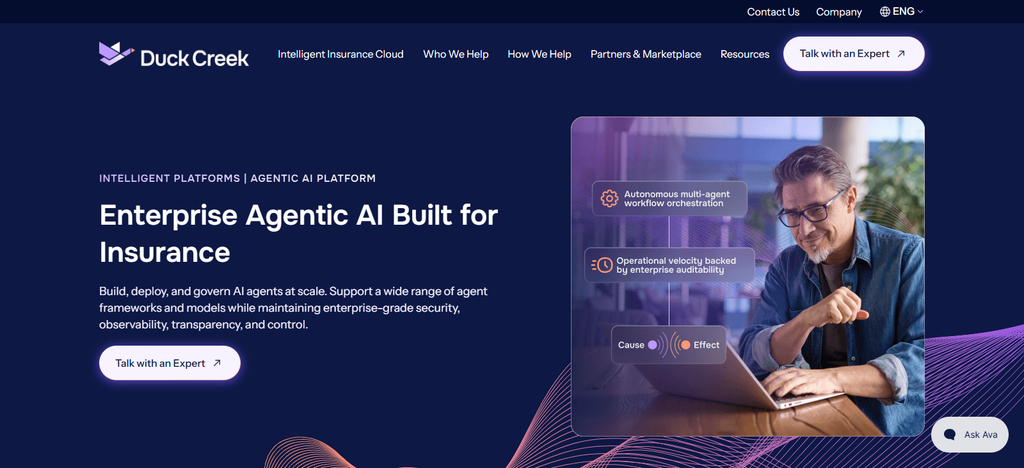
The platform exposes fraud indicators, severity predictions, risk signals and next-best-action recommendations in claims workflows. The low-code configuration enables insurers to customize rules and workflows, and the platform focuses on auditable, explainable automation and integration across the Duck Creek ecosystem. Duck Creek Introduces Agentic FNOL to Revolutionize Claims Intake with Intelligent, Real-Time Automation | Duck Creek
What it does best: Duck Creek provides insurance tech for claims administration, workflow management and AI-enabled operations to help insurers modernize claims processes and improve coordination across insurance functions.
Where It Falls Short: The power of AI will vary depending on the product, how it is deployed and what integrations are available. Organizations should know what functions are available natively and what requires additional solutions or configuration.
Best For: Property and casualty insurers looking to modernize claims administration, automate operational workflows and add AI capabilities to their current insurance technology environments.
Crucial Features
- AI-enabled insurance operations.
- Claim administration support.
- Workflow management automation.
- Insurance processes that can be configured.
- Integration with insurance systems
7. Tractable
Tractable utilizes computer vision and applied AI for automotive claims from the moment of filing to the settlement. Its visual-assessment artificial intelligence analyzes customer-submitted photos and videos to assess vehicle damage, estimate repair costs, validate repair estimates, assist with repair-versus-replace decisions and identify the proper parts.
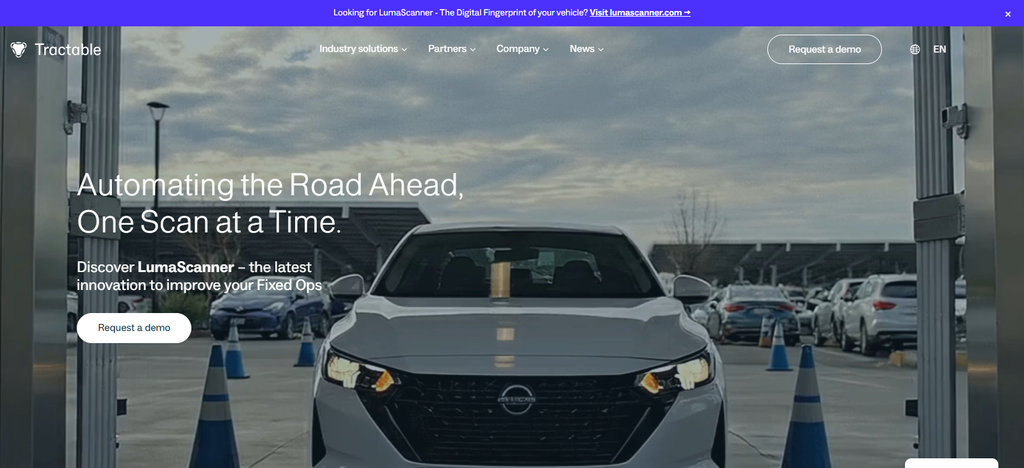
Tractable Auto Reviewer can process claims in minutes, automatically reviewing estimates and flagging inconsistencies, reducing the need for manual review and supporting straight-through processing for appropriate claims. The platform also helps body shops source parts and makes sure that insurer repair standards are applied sooner in the process.
Tractable provides integrations via flexible desktop tools and APIs, enabling Tractable to plug into claims processing and fleet maintenance workflows. Its strengths are in auto physical damage, estimation and visual claims automation.
Where It’s Strong: Tractable leads in computer vision for insurance damage assessment, helping analyze photos to assess vehicle and property damage, estimate repairs, and speed up claims assessment workflows.
Weaknesses: Its strongest capabilities are more visual-damage oriented than full claims administration. Image quality, damage complexity and specialist review can influence assessment outcomes.
Best For: Auto and property insurers seeking AI-powered visual inspections, vehicle damage assessments, repair estimates and faster processing of image-based insurance claims.
Essential Features
- AI analysis of pictures
- Assessment of vehicle damage.
- Damage to property assessment.
- Automatic visual inspection means.
- Support for estimating repairs
8. CCC Information Solutions, Inc.
CCC Intelligent Solutions offers an AI-fueled claims and repair ecosystem, with a very strong emphasis on automotive insurance. Its platform connects insurers, repairers, automakers and suppliers, offering photo capture, claims documentation, repair scheduling, two-way texting, triage, estimating, intelligent review and subrogation. CCC First Look ingests photos from consumers and salvage providers, validates them with AI, and informs routing and workflow decisions including total-loss and casualty potential.

Computer vision can turn images of vehicle damage into line-by-line estimates, predict the damage and cost, flag possible injuries and produce subrogation demands. A great option for auto-centric, ecosystem-connected claims operations, CCC’s IX Cloud uses an event-driven, microservices-based architecture to deliver AI insights across existing CCC applications, customer workflows and partner systems.
What’s good: CCC Intelligent Solutions provides insurance technology that combines AI, automotive data, damage estimation and repair workflows to help auto insurers with vehicle claims assessment and resolution.
Where it is weaker: Its best specialty is automotive insurance and collision repair. Insurers with unrelated claim categories might need more platforms to automate claims on a wider scale.
Best For: Auto insurers, collision repair networks and claims organizations seeking vehicle damage assessment, repair cost estimation, claims workflow coordination and automotive data intelligence.
Important Features
- AI-based vehicle damage estimation.
- Automated analysis of repairs
- Processing of accident claims.
- Auto data intelligence.
- Support for digital claims workflow.
9. Snapsheet
Snapsheet is a P&C claims management platform that uses a centralized claim file, configurable AI agents and workflow automation. It indexes and captures documents, communications, notes, vendor activity, claim updates and actions in one searchable location. Using natural language at the prompt level, insurers can configure AI agents to specify persona, tasks, rules, scoring logic and output format.

Agents use claim context from documents, communications, financials, policy data, notes and claim history to aid in decisions and automate work. Snapsheet uses the existing rules, guardrails and protocols of claims systems to minimize from-scratch configuration.
If you’re a carrier seeking configurable claims automation, you’ll appreciate the pre-engineered workflows that can be adapted to different claim types, rule sets and scenarios.
Where It’s Strong: Snapsheet is focused on digital claims management, virtual appraisals and automated workflows, helping insurers streamline claim handling, improve communication and manage vehicle damage assessments.
Where It’s Not So Strong: Its features lend themselves particularly to digital claims and appraisal workflows. Insurers will need to determine if the available automation meets their specific claim types and operational requirements.
Ideal For: Property and casualty insurers who want digital claims management, virtual vehicle appraisals, better customer communication and more efficient claims processing.
Main Features
- Managing claims digitally.
- Virtual car valuations.
- Claims processing automation.
- Customer involvement in digital.
- Ushur 5. Coordination of claims process.
10. Ushur
Ushur is an AI-powered customer-experience and intelligent-automation platform that enables insurers to automate high-volume, document and communication intensive journeys. In claims scenarios it can help with digital intake, guided FNOL, status updates, document collection, reminders and proactive policyholder communications across channels such as email, SMS, web and mobile.

It’s AI that combines conversational automation and document understanding to extract information, guide customers through required steps and reduce repetitive contact-center work. Ushur’s general positioning is as a complementary layer to core claims systems:
it automates engagement and information-gathering steps, then feeds structured data and completed workflows into insurers’ existing systems. This makes it useful for carriers looking for faster intake, better customer experience and less manual follow-up, rather than a complete claims adjudication replacement.
Where It’s Strong: Ushur leverages conversational AI and intelligent automation to enhance insurance consumer interactions, automate First Notice of Loss intake, collect claim information and streamline policyholder communication.
Where it’s weak: Its core competency is client engagement and process automation, not specialized damage estimation or independent claims adjudication. Complex investigations may need specialized claims platforms.
Best For: Insurance companies who want to automate First Notice of Loss, enhance client engagement, gather claim information and enable communication during the claims process.
Main Features
- Conversational AI automation.
- Automated First Notice of Loss
- Digital claim intake.
- Smart customer communication.
- automating the insurance workflow.
How to Choose the Best AI Agent for Insurance Claims Processing?
Claims Automation Capabilities: Select an AI agent that automates claim intake, document gathering, policy verification, assessment, and workflow management to reduce repetitive tasks and improve overall processing efficiency.
Precision and Dependability of AI: Assess the platform’s accuracy in data extraction, claims data analysis, error detection, and recommendations to ensure consistent processing and reliable insurance decisions.
Fraud Detection Capabilities: Seek AI agents that can spot suspicious patterns, identify unusual claim activities, compute risk scores, and aid in investigations to assist insurers in minimizing fraudulent claims.
Document Processing: Select solutions that can automatically extract, classify, validate and organize insurance documents such as claim forms, medical records, invoices, photographs and supporting evidence.
Integration Compatibility: Verify that the AI agent is compatible with the existing claims management software, policy administration systems, CRM platforms, payment systems, and other critical insurance technology infrastructure.
Data Security and Compliance: Seek vendors with features like encryption, controls for access, and audit trails, and with the necessary regulatory compliance capabilities to safeguard sensitive policyholder data throughout claims processing operations.
Human Monitoring and Control: Select AI agents that support human review, manual approvals, exception handling, and escalation workflows to ensure adjusters retain control over complex or high-value claims.
Pricing and Scalability: Consider implementation costs, licensing models, customization needs and scalability to ensure the AI agent can scale with growing claim volumes without incurring any unnecessary operational costs.
Conclusion
AI agents are revolutionizing insurance claims processing with automated claim intake, document verification, fraud detection, damage assessment and workflow management. Platforms like Five Sigma, Sprout.ai, Shift Technology, Guidewire AI, Tractable and CCC Intelligent Solutions have different capabilities to help insurers improve operational efficiency and decision making.
But the right solution depends on automation requirements, AI accuracy, integration compatibility, data security, scalability and oversight by humans. Insurance companies should weigh the pros and cons of each platform before implementing it. By using the right AI agent, insurers can reduce manual workloads, improve policyholder experience, and optimize claims operations, while enabling more efficient services.
FAQ
What Are AI Agents for Insurance Claims Processing?
AI agents are intelligent software systems that automate insurance claims activities, including claim intake, document verification, fraud detection, damage assessment, and workflow management using artificial intelligence.
Which Are the Best AI Agents for Insurance Claims Processing?
Some leading solutions include Five Sigma (Clive), Sprout.ai, Shift Technology, Bevaya, Guidewire AI, Duck Creek Technologies AI, Tractable, CCC Intelligent Solutions, Snapsheet, and Ushur.
How Do AI Agents Automate Insurance Claims Processing?
They automate repetitive tasks such as collecting claim information, extracting documents, verifying policy details, identifying suspicious activities, assessing damages, and routing claims for review.
Can AI Agents Detect Insurance Fraud?
Yes. AI-powered fraud detection systems analyze claims data, identify unusual patterns, generate risk scores, and flag suspicious activities for further investigation by insurance professionals.