

AI agents are changing the game in compliance monitoring for financial institutions. Compliance teams can use AI agents to triage cases, screen customers, investigate suspicious activity and prepare regulatory reports, rather than having to manually review every alert, transaction and customer record.
These tools use machine learning, automation, and natural-language processing to decrease manual workload, improve accuracy, and expedite decision-making. But supervision by humans remains crucial, especially in high-risk cases, regulatory filings, and final approvals. Here are some top AI-agent solutions for compliance monitoring in banking, fintech, payments, and crypto.
What Are AI Agents for Compliance Monitoring?
AI Agents for Compliance Monitoring are intelligent software systems that employ artificial intelligence, machine learning, and automation to help businesses monitor regulatory requirements, detect suspicious activities, identify compliance violations, and manage risk.
These agents can monitor transactions, customer information, business operations and internal policies on an ongoing basis for potential problems. They automate Know Your Customer (KYC) verification, Anti-Money Laundering (AML) monitoring and sanctions screening, risk assessment, alert prioritization and compliance reporting.
Unlike traditional rule-based compliance software, AI agents can evaluate complicated patterns, process large data sets and support investigation workflows with less manual effort. They also help compliance teams with audit trails, improve monitoring efficiency, and respond to regulatory changes. However, supervision by humans is still required to review high-risk alerts, approve critical decisions and ensure regulatory accountability.
Quick Comparison Table
| AI Agent / Platform | Main Compliance Focus | Key AI Capabilities | Best For |
|---|---|---|---|
| 1. Alloy | KYC, KYB, AML monitoring | Watchlist screening, alert triage, investigations, SAR preparation | Banks and fintech companies |
| 2. Unit21 | AML and fraud monitoring | Automated investigations, evidence gathering, alert review, SAR drafting | Financial crime investigation teams |
| 3. Sardine | Transaction monitoring and fraud | Behavioral analysis, sanctions screening, KYC review, risk detection | Fintechs and payment businesses |
| 4. NICE Actimize | Financial crime and regulatory compliance | AI investigation, alert triage, transaction monitoring, case summarization | Large financial institutions |
| 5. SymphonyAI | AML, sanctions and KYC monitoring | AI investigation agents, SAR narratives, name screening, case summaries | Banks and financial enterprises |
| 6. Lucinity | AML investigations and suspicious activity | Evidence gathering, adverse media research, case summaries, SAR drafting | Compliance investigation teams |
| 7. WorkFusion | AML, sanctions and KYC alert review | Automated alert adjudication, PEP screening, adverse media review, EDD | Banks with high alert volumes |
| 8. Bretton AI | KYC, KYB and AML compliance | AI-powered alert adjudication, due diligence and compliance reviews | Fintech compliance teams |
| 9. Oscilar | AML, fraud and risk monitoring | AI agents for alert review, sanctions screening, SAR narratives and KYC | Financial risk management teams |
| 10. Hawk | AML and transaction monitoring | Investigative AI, suspicious activity analysis, SAR narrative drafting | Banks and AML teams |
1. Alloy
Alloy is a fraud, identity and compliance orchestration platform for banks and fintechs with more than 900 institutions on its customer list. The Actionable AI layer comes with an AI Assistant and agents for watchlist screening, AML investigation, fraud triage, document review, KYC/KYB research, SAR/CTR preparation and perpetual KYC.

It powers real-time risk decisioning across onboarding and the customer lifecycle with 300+ integrated data partners. Alloy does not have standard pricing, costs are typically based on decisions, modules and volume. Human supervision is baked in. Agents assemble evidence and recommendations, and analysts maintain final sign-off, aided by audit trails and model-governance documentation.
Why it’s great: Alloy provides flexible identity verification, fraud prevention and compliance workflows. Its orchestration capabilities allow financial institutions to efficiently handle customer onboarding, KYC checks, risk decisions and ongoing surveillance.
What Alloy doesn’t do: Alloy’s functionality is limited to configured workflows, integrations and available data sources. Complex requirements organizations may require technical implementation, customization and additional compliance tools.
Ideal for: Banks, fintech companies, and financial institutions looking for centralized identity verification, fraud prevention, customer onboarding, and automated compliance decision-making.
Key Features
- Automating KYC and KYB verifications.
- Checking identity and preventing fraud.
- AML risk assessment and screening.
- Configurable compliance work-flows.
- Monitoring the customer life cycle.
2. Unit 21
Unit21, rebranded in March 2026 to “AI Risk Infrastructure,” is less about onboarding identity verification and more about fraud and AML operations. Its AI agents perform alert triage, transaction monitoring and fraud detection, sanctions screening, EDD, case investigation, evidence collection, drafting narratives and pre-populated SAR/CTR filings.

The platform features configurable rules, behavioral models, real-time monitoring, graph analysis, backtesting, and shadow mode. Includes AML, sanctions, fraud and FinCEN/FINTRAC filing workflows, with regulator-ready audit trails.
We normally price on a customized basis based on transaction/alert volume and modules deployed. Human review is required by design. Agents operate on a four-level autonomy ladder, and outcomes are approved by analysts before they are filed.
Where it excels: Unit21 is strong on financial crime prevention, featuring customizable transaction monitoring, fraud detection, alert management and investigation workflows. It helps compliance teams to structure their reviews of suspicious activity and case documentation.
What it lacks: Unit21 is focused on financial crime compliance, not every regulatory category. The quality of implementation, monitoring configuration and investigation depends on the data available and operational processes.
Ideal for: Banks, fintech companies, payment companies and compliance teams that need flexible AML monitoring, suspicious activity investigations, fraud detection and case management.
Main Features
- Transaction monitoring with AI assistance.
- Automatic detection of suspicious activities.
- Management of Fraud & AML Alerts.
- Case investigation and recordkeeping.- Support with regulatory reporting
3. Sardines
Sardine, founded in 2020, is an agentic fraud prevention and financial crime platform that brings together device intelligence, behavioral biometrics, identity verification, AML, KYC/KYB, and real-time transaction monitoring. The Agent Hub has ten named agents: OSINT Search, Data Analyst, Rule Assistant, Graph Analyst, Transaction Monitoring, PEP/Sanctions Screening, Business Due Diligence, Document KYC, and SAR Generation.

It focuses on real-time fraud signals, consortium intelligence, case management, SLA tracking and two eyes review. Regulatory coverage includes AML monitoring, sanctions/PEP screening, SAR generation, and direct filing to FinCEN. Pricing is quoted and will vary based on volume, geography, payment method and modules. Agents can automate analysis and investigations but compliance teams have review and final decision rights.
Where it shines: Sardine combines fraud prevention, behavioral intelligence, identity verification and financial crime monitoring. The risk infrastructure helps companies to identify suspicious customer behavior and possible fraud transactions.
Weakest point: Sardine’s strongest points are fraud and financial crime prevention. Organizations with broad enterprise regulatory governance requirements may require compliance management systems that complement each other.
Best for: Fintech companies, digital banks, payment providers, and financial platforms looking for integrated fraud detection, transaction monitoring, identity verification, and risk management.
Main Features
- Risk behavior analysis.
- AI for fraud detection.
- KYC and identity verification.
- Transaction monitoring.
- AML and sanctions screening capabilities.
4. NICE Actimize
NICE Actimize is a proven enterprise financial crime suite, with X-Sight and Xceed platforms supporting AML, fraud, sanctions, market abuse, KYC/CDD, case management and regulatory reporting. Xceed launched in 2020, agentic AI capabilities launched in 2025 with X-Sight ActOne InvestigateAI and Xceed AI Agents. Its agents automate alert triage and prioritization, case summaries, investigation planning and SAR narratives with human checkpoints.

The platform provides real-time cross-channel fraud prevention, transaction monitoring, behavioral analytics, network risk detection and model-driven AML surveillance. It caters to big banks, community institutions, insurers, crypto firms and regulators. Pricing is enterprise negotiated and typically includes implementation and integration costs. Human supervision continues to be key, particularly for investigations, filings and model governance.
What it does well: NICE Actimize has broad financial crime and compliance offerings for large institutions. Its analytics and automation capabilities power transaction surveillance, AML investigations, fraud detection and regulatory compliance operations.
Where it falls short: Its enterprise-leaning architecture can demand a lot of implementation planning, integration resources and specialized expertise. The deployment and operational requirements can be demanding for smaller organizations.
Best For: Large banks, financial institutions and regulated enterprises managing complex AML requirements, transaction surveillance, fraud prevention and financial crime investigations.
Main Features
- AI-driven AML monitoring.
- Control and monitoring of transactions.
- Workflows of financial crime investigation.
- Fraud Detection & Prevention.
- Reporting on regulatory compliance.
5. Symphony AI
SymphonyAI launched its Sensa financial-crime platform in 2021, and expanded it with the 2022 acquisition of BAE Systems’ NetReveal. In October 2025 it launched Sensa Risk Intelligence, an AI-native modular suite that includes Sensa Detection, Investigation, Agent and Data. It employs autonomous agents for SAR narrative, case summary, web research and name-screening, trained on institution-specific policies and connected via APIs.

AML transaction monitoring, sanctions/PEP screening, customer due diligence, fraud, case management and regulatory reporting. The platform is geared toward big banks and insurers and can be deployed either in the cloud or on-premises and scaled modularly. Pricing is customized, enterprise-oriented. Explicit human supervision: Agents can act autonomously, but institutions control parameters, approvals, and analyst review at certain points in the workflow.
Strengths: SymphonyAI brings together enterprise AI, financial crime analytics and intelligent automation. Its financial services solutions enable AML investigations, sanctions screening, customer risk assessment and compliance operations.
Where it’s weaker: The wide range of enterprise features can lead to complex configuration and integration needs. Businesses should review individual modules closely to ensure they meet their compliance monitoring needs.
Suitable for: Banks, financial services firms and large enterprises that want AI-assisted AML investigations, sanctions monitoring, customer due diligence and financial crime management.
Main Features
- AI for financial crime detection.
- Automated AML Investigations.
- Sanction and watch list screening.
- Customer risk assessment
- Automated case management and reporting.
6. Lucinity
Lucinity is an AI-native financial-crime investigation platform. Lucinity centers around its Luci agent, which gathers evidence, summarizes cases, conducts adverse-media research, and writes editable SAR narratives. It’s Luci Plugin layers these capabilities on top of existing web-based compliance systems, allowing institutions to add investigation support without changing their monitoring stack. Sanctions data is sourced via partners. Lucinity’s strongest coverage is investigation and case management.
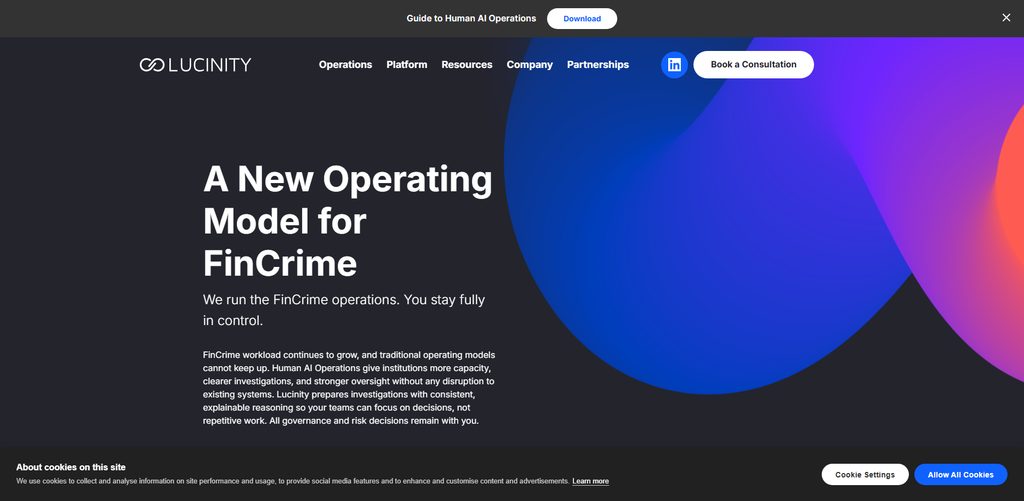
Lucinity does not offer onboarding identity verification. It supports alert intake from multiple transaction monitoring systems, four-eyes review, auditability and analyst-controlled decisions — Luci prepares cases but does not make final compliance decisions. No standard pricing is published; it’s generally negotiated based on deployment scope and volume of cases. This is an AI investigation layer for mid-size banks, fintechs and payment companies.
Where it excels: Lucinity focuses on AI-assisted financial crime investigations and compliance productivity. Its smart investigation capabilities help analysts review alerts, organize evidence, summarize cases and prepare suspicious activity documentation.
Where it’s weaker: Lucinity is more focused on financial crime investigations than on overall enterprise compliance management. Its effectiveness is dependent on investigation workflows, data quality and human review.
Best for: AML teams, banks, fintech companies and financial crime investigators looking for faster alert reviews, organized investigations and better compliance documentation.
Main Features
- AI aided AML investigations.
- Case summarization (automated).
- Collection and organization of evidence.
- Support for the investigation of suspicious activity.
- Compliance documentation support.
7. WorkFusion
February 2026: UiPath acquires WorkFusion, which offers named, role-based AI agents to automate compliance alert review across existing systems. Its agents are Evelyn for sanctions/PEP screening, Tara for payment screening, Evan for adverse media, Edward for EDD, Isaac for AML transaction-monitoring alerts and Kayla for KYC. These agents make decisions on routine alerts based on confidence thresholds and escalate uncertain or higher risk alerts to human reviewers.
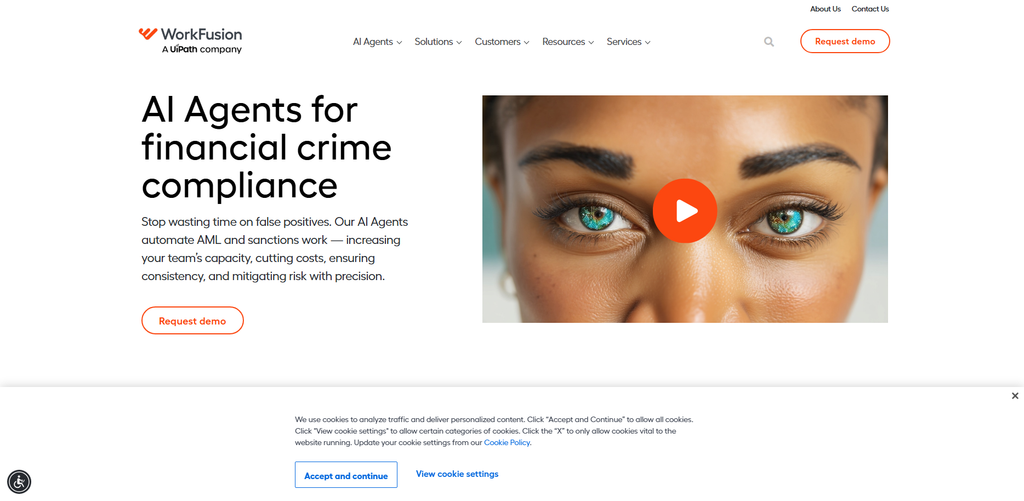
WorkFusion is more of an automation overlay than a full compliance platform, without native capabilities for detection, case management, filing and onboarding identity. SOC 2 controls, support for on-premises, private-cloud and customer-cloud deployments. Pricing is enterprise custom, determined by alert volume and scope of automation. It is a good fit for banks that want scalable first line review without replacing core monitoring systems.
What it does best: WorkFusion is focused on intelligent automation for financial crime compliance. Its digital workforce automates repetitive processes around KYC, AML alerts, sanctions screening, adverse media reviews and customer due diligence .
Where it’s weaker: WorkFusion’s automation can involve process mapping, system integration and continuing configuration. If an organization has highly customized compliance procedures, it should assess workflow compatibility before implementation.
Best for: Financial institutions, banks, and compliance operations teams that process high volumes of KYC reviews, AML alerts, sanctions screening, and repetitive investigations.
Important Features
- Digital workers powered by AI.
- KYC automated processing.
- Review of AML alerts.
- adverse media and sanctions screening.
- Improved due diligence automation.
8. Bretton AI
Bretton AI, formerly Greenlite AI, was founded in 2023 and rebranded in February 2026 after a $75 million Series B raise. It offers AI agents for L1/L2 compliance reviews covering alert adjudication, EDD, KYC/KYB, sanctions investigations, monitoring alerts and SAR drafting. It sits on top of the banks’ existing monitoring and case management systems and uses institution-specific policies and tools.
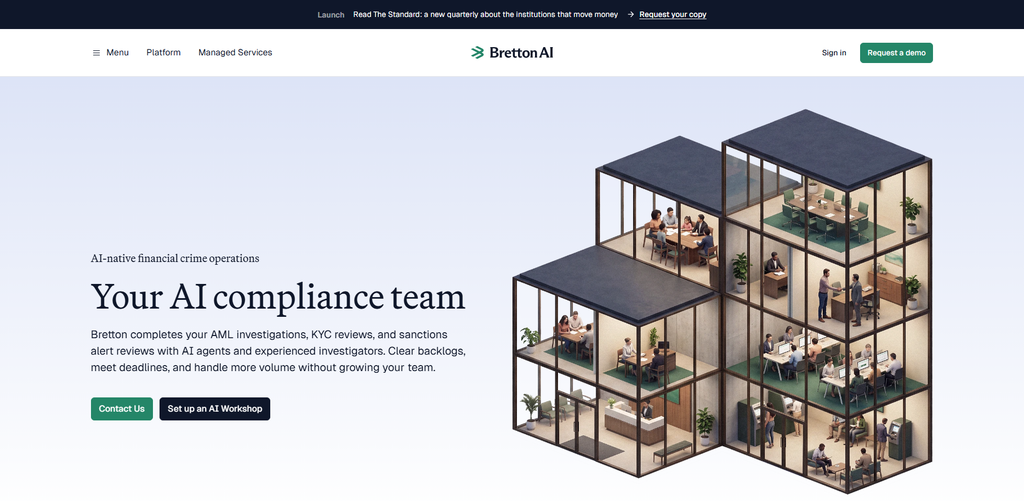
Latest capabilities include Workflows, Agent Artifacts to populate bank templates and Agentic Upload to convert CSV/Excel files to cases. Regulatory coverage is focused on AML, KYC/KYB, sanctions and audit-ready documentation.
It has introduced outcome-based instead of headcount-based pricing to the market via its AI-native managed service. Human supervision is central. Agents log their reasoning, evidence, and model version and analysts approve completed cases.
Where it excels: Bretton AI is focused on agentic AI for financial crime compliance. Its platform automates complex compliance workflows including customer due diligence, alert investigation, evidence collection and risk assessment.
Where it falls short: Its capabilities should be assessed against the organization’s specific regulatory requirements, data infrastructure, and investigation processes. Buyers should consider integrations and deployment maturity.
Best for: Banks, fintechs and financial compliance teams who want to automate KYC, KYB, AML investigations and other resource-intensive due diligence operations.
Main Features
- Agentic AI-compliant workflows.
- Customer due diligence automation.
- Automation of KYC and KYB.
- AML investigation support.
- Collecting proof of compliance.
9. Oscilar
Oscilar is a real-time risk-decisioning platform. In June 2026, it launched Agent Hub, with more than 30 recommendation AI agents. Its agents drive AML alert review, SAR narratives, sanctions and PEP screening, KYC/KYB, CTR filing and other compliance workflows. Oscilar uses its decisioning engine and AI recommendations to help institutions automate parts of their onboarding, fraud and financial-crime operations, while still keeping control over their policies.

Its AML product line dates back to 2024, making it a newer entrant compared to established enterprise suites. It has more than 100 financial-institution customers, including SoFi and MoneyGram. Pricing is not public and likely to vary based on the transaction, decision and module volume. Its agents mostly recommend, rather than independently decide, to keep analyst review for sensitive or complex cases.
What it does well: Oscilar offers AI-driven risk decisioning and financial crime monitoring. Its platform integrates fraud prevention, AML workflows, customer risk assessment and transaction intelligence in configurable decision systems.
Where it’s weak: Oscilar’s focus on financial risk and decisioning may not address all enterprise governance needs. Businesses need to consider regulatory coverage, integration needs and customization requirements.
Best for: Fintech companies, digital banks, lenders and payment providers who need one solution to manage fraud prevention, AML monitoring, transaction risk assessment and automated decision making.
Important Characteristics
- AI-powered risk decisioning
- Transaction monitoring in real time.
- Stop and identify fraud.
- AML compliance procedures.
- Evaluation of the client’s risk.
10. Hawk
Hawk is an AI native AML surveillance vendor that offers transaction monitoring, screening, case investigation and an AI overlay for legacy compliance systems. In March 2026, it rolled out its AML Investigative Agent that collects data, summarizes cases, writes SAR narratives and builds audit trails. Hawk also has a CDD Agent that can be deployed as SaaS or in customer’s cloud, with the option of bringing custom models.

It provides regulatory coverage for AML transaction monitoring, sanctions screening, SAR/CTR filing to FinCEN, four-eyes review and auditability. By the time of the Series C in April 2025, the company had more than 80 clients. In 2026, Commerzbank rolled out its AML AI Extended Risk Model. Pricing is custom and enterprise-led. Banks can configure human supervision at each step of the workflow, to put controls in place for approvals and sign-offs.
Where it shines: Hawk is all about AI-driven anti-money laundering and financial crime prevention. Its monitoring technology allows institutions to analyze transactions, identify suspicious patterns, prioritize alerts and support compliance investigations.
Where it falls short: Hawk is mainly focused on AML and financial crime monitoring. Further solutions may be required for organizations needing more comprehensive regulatory governance, employee compliance, or enterprise-wide policy management.
Ideal for: Banks, payment providers, fintech companies and regulated financial institutions looking for advanced transaction monitoring, AML detection and suspicious activity investigation.
Main Features
- AI surveillance of transactions
- Detection of suspicious activity.
- AML risk rating.
- Alert prioritization automation.
- Support financial crime investigations.
How to Choose the Best AI Agent for Compliance Monitoring?
Identify Your Compliance Needs: Before you choose an AI agent, you’ll need to know whether your business needs anti-money laundering (AML) monitoring, know your customer (KYC) verification, fraud detection, sanctions screening, regulatory reporting or broader compliance automation.
Assess AI Agent Capabilities: See if the platform provides automated investigations, smart alert prioritization, risk assessment, suspicious activity detection, and AI-driven decision support for routine compliance tasks.
Regulatory Compliance: Verify that the AI agent adheres to all necessary regulations such as AML, KYC, KYB, GDPR, and other financial regulations applicable to your business in different regions and industries.
Real-time Monitoring: Select platforms capable of continuously monitoring transactions, customer activities, suspicious behaviors, and regulatory risks in an effort to identify any potential compliance breaches before they escalate into major problems.
Review Risk Detection Accuracy How accurately does the platform identify suspicious transactions, unusual patterns, fraud indicators, false positives and emerging compliance risks from reliable monitoring data?
Assess Compatibility for Integration: Select an AI agent that can be seamlessly integrated with existing banking systems, CRMs, APIs, identity verification platforms, transaction databases, and compliance management software.
Data Security and Human Monitoring: Review encryption, control of access, audit trails, explainable AI decisions, and human approval workflows to ensure accountability and protect sensitive compliance data.
Pricing and Scalability Comparison: Assess implementation costs, subscription plans, monitoring capabilities, customization options, and scalability to ensure the platform can accommodate increasing transaction volumes and evolving regulatory demands.
Conlusion
Selecting the best AI agents for compliance monitoring depends on the business requirements, regulatory coverage, automation capabilities and risk management needs. Some of the platforms are Alloy, Unit21, Sardine, NICE Actimize, SymphonyAI, Lucinity, WorkFusion, Bretton AI, Oscilar, and Hawk that offer various features for AML monitoring, KYC verification, fraud detection, transaction surveillance, and automated investigations.
Before choosing a solution, businesses should consider integration compatibility, data security, reporting capabilities, scalability and oversight by humans. The right AI compliance agent can help you reduce manual workloads, improve suspicious activity detection, strengthen regulatory processes and support more efficient compliance operations.
FAQ
What are the best AI agents for compliance monitoring in 2026?
Some leading AI compliance platforms include Alloy, Unit21, Sardine, NICE Actimize, SymphonyAI, Lucinity, WorkFusion, Bretton AI, Oscilar, and Hawk. They support different financial crime monitoring and compliance automation requirements.
How do AI agents help with compliance monitoring?
AI agents analyze transactions, customer information, and business activities to identify suspicious patterns, detect potential violations, automate investigations, prioritize alerts, and support regulatory reporting.
Can AI agents automate AML and KYC compliance?
Yes. AI-powered platforms can automate several AML and KYC tasks, including identity verification, customer due diligence, transaction monitoring, sanctions screening, risk assessment, and suspicious activity reviews.
Which AI agents are best for AML monitoring?
Unit21, NICE Actimize, SymphonyAI, Lucinity, WorkFusion, and Hawk offer capabilities focused on AML monitoring, suspicious activity detection, financial crime investigations, and compliance workflows.
Can AI agents detect suspicious financial transactions in real time?
Yes. Platforms with real-time monitoring capabilities analyze transaction patterns, customer behavior, and risk indicators to identify potentially suspicious activities and generate alerts for further investigation.