

In this article, I will talk about the Best AI Agents for Procurement Automation in 2026, to help companies streamline purchasing, sourcing, supplier management and spending operations. As companies’ procurement activities become more complex, AI-powered solutions are key to reducing manual work and improving decision-making. I will explore platforms like Coupa, SAP Ariba, Ivalua, GEP SMART and other leading tools, outlining their key features, strengths, weaknesses and suitability for various business needs.
What Are AI Agents for Procurement Automation?
AI agents for procurement automation are intelligent software systems that leverage artificial intelligence, machine learning and automated workflows to manage purchasing activities with minimal manual intervention. They enable companies to optimize procurement processes including supplier discovery, purchase requests, sourcing, order management, invoice processing, contract management, and spend analysis.
Unlike traditional procurement tools that essentially just follow pre-set instructions, AI agents can evaluate information, understand business requirements, make recommendations and take specific actions as defined by their permissions.
They also enable procurement teams to assess suppliers, compare quotes, track spend, automate approvals, and make better purchasing decisions. These agents link to ERP, accounting and enterprise systems to streamline procurement functions to be more efficient, organized and data-driven.
Quick Comparison Table
| AI Procurement Agent | Best For | Key AI Capabilities | Main Strength |
|---|---|---|---|
| 1. Coupa | Enterprise procurement automation | AI agents, spend analysis, purchasing, invoice automation | Comprehensive spend management |
| 2. SAP Ariba | Large enterprises using SAP | Joule AI agents, sourcing, supplier management, purchasing workflows | Deep SAP ecosystem integration |
| 3. Ivalua | End-to-end source-to-pay automation | IVA, sourcing intelligence, supplier management, contract workflows | Unified procurement automation |
| 4. GEP SMART | Enterprise procurement and supply chains | MINERVA AI, spend analytics, sourcing, supplier management | Integrated procurement and supply chain capabilities |
| 5. Zycus Merlin AI | Autonomous procurement workflows | AI agents, sourcing, spend analysis, supplier management | Agentic procurement capabilities |
| 6. Zip | Procurement intake and approvals | AI-powered intake, request routing, workflow automation | Simplified purchasing requests |
| 7. Fairmarkit | Tail-spend and strategic sourcing | Supplier discovery, RFQs, sourcing automation, award workflows | Automated sourcing processes |
| 8. Keelvar | Complex sourcing and e-auctions | AI sourcing orchestration, optimization, automated RFQs | Advanced sourcing optimization |
| 9. Pactum | Supplier negotiations | Autonomous negotiation, supplier communication, agreement optimization | Scalable supplier negotiations |
| 10. Levelpath | Intake-to-procurement workflows | AI reasoning, request management, sourcing, orchestration | User-friendly procurement automation |
1. Coupa
Coupa is an AI-native, cloud-based Business Spend Management platform that includes sourcing, procurement, invoicing, payments, expenses and supply-chain collaboration. Coupa Navi agents automate intake, policy checking, sourcing event creation, contract summarization, supplier onboarding and payment workflows—all while keeping high impact decisions under human guardrails.

The platform allows for strategic sourcing through AI-driven event configuration and supplier suggestions, and provides spend data to identify savings, fraud, and supplier risk. Coupa scales from mid-market to global enterprises, with 250+ native connectors, APIs and integrations for SAP, Oracle and Microsoft Dynamics. Pricing is usually subscription-based and customized according to modules, users and transaction volume.
Where It’s Strong: Coupa provides complete procurement automation, including AI-powered spend management, purchasing workflows, supplier management, invoice processing and analytics, to help enterprises get more visibility and efficiency from their spending.
Where it’s weaker: The full suite of enterprise features can make it complex to implement. The transparency of pricing and customization needs can be a hurdle for smaller businesses with limited procurement budgets.
Best For: Large and mid-sized companies looking for automated procurement, intelligent spend management, supplier collaboration, purchasing controls and better visibility into organizational spend.
Key Characteristics:
- Procurement automation through AI.
- intelligent spending analysis and management.
- Supplier management and cooperation.
- Automated purchasing and invoicing procedures.
- Reporting and analytics for procurement.
2. SAP Ariba
SAP Ariba is SAP’s enterprise source-to-pay and supplier-network platform that links procurement, sourcing, contracts, supplier management and a large global business network. The AI capabilities such as SAP Joule and SAP Business AI automate sourcing from request to award, surface supplier insights, assess risk and guide supplier lifecycle activities.
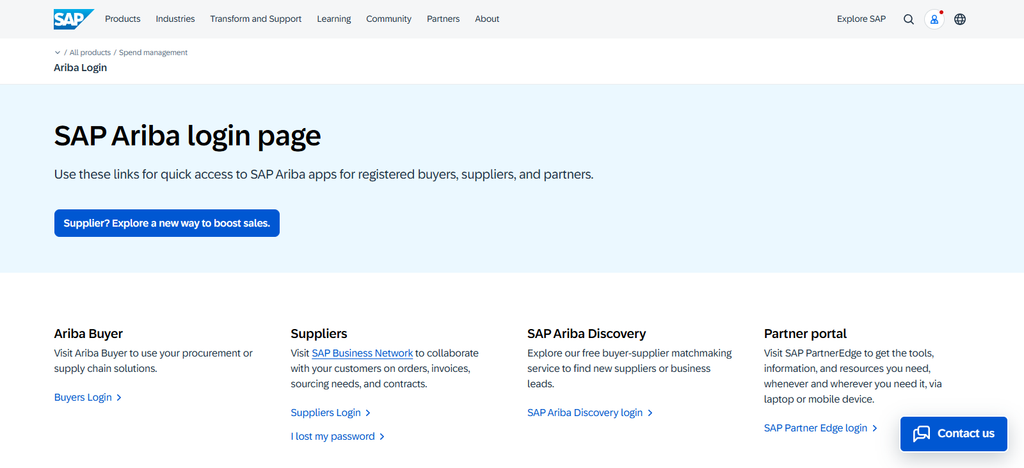
Workflow automation includes requisitions, approvals, sourcing events, contracts and supplier onboarding. Supplier 360 profiles aggregate performance, risk and compliance data. The platform is also highly scalable for large, multi-national organizations and has deep integration with SAP S/4HANA, SAP Integration Suite and third-party ERPs through open APIs. Pricing is modular and negotiated with enterprises, usually on the basis of the chosen solutions, users and network usage.
What It Does Well: SAP Ariba offers end-to-end source-to-pay processes, supplier collaboration, sourcing automation, purchasing management and integration with SAP enterprise systems for complex procurement operations.
Where It Falls Short: It’s so feature rich that it could need special implementation and training for staff, and ongoing administration. Smaller organizations without a dedicated procurement technology team could find it more challenging to roll out.
Best For: Large enterprises already on SAP that require supplier connectivity, strategic sourcing, purchasing automation, contract management and enterprise-wide procurement visibility.
Main Features:
- AI-enabled purchasing with Joule.
- Automated strategic sourcing.
- Supplier life cycle management.
- Purchase order and invoice handling.
- SAP Ecosystem Integrations
3. Ivalua –
Ivalua offers a single, low-code/no-code Source-to-Pay platform that includes intake, sourcing, contracts, supplier management, procurement and accounts payable. IVA, the agentic AI assistant, searches, analyzes and acts across spend, supplier, contract and transaction data to help teams configure the platform, troubleshoot integrations and execute procurement processes.

Ivalua automates sourcing events, approvals, contract workflows, supplier onboarding and cross functional handoffs on one shared data model. Supplier management includes onboarding, performance, risk and lifecycle controls and embedded analytics connect spend data to sourcing and contract decisions.
It scales across complex, multi-ERP environments via prebuilt connectors, APIs, ETL/EAI and an Integration Hub; pricing is enterprise subscription-based and scope-based.
Strengths: Ivalua provides flexible source-to-pay automation for sourcing, supplier management, contracts, purchasing and invoicing on a single platform built for complex enterprise procurement needs.
Where it’s worst: The extensive configuration options and enterprise functionality may result in more complex implementations that require careful workflow planning, technical resources and training to ensure successful adoption by the organization.
Best For: Companies looking for full end-to-end procurement automation that can be customized to include sourcing, supplier lifecycle management, contract administration, purchasing and accounts payable workflows.
Important Features:
- IVA intelligent virtual assistant
- Source to pay automation.
- Vendor lifecycle management.
- Contract lifecycle management.
- Analytics and Reporting for Procurement.
4. GEP SMART™
GEP SMART is a single, cloud-based procurement-orchestration platform that includes spend analysis, sourcing, contract management, supplier management, procure-to-pay, savings tracking and financial management. Its agentic orchestration engine handles sourcing, contracting, purchasing, and supplier tasks in a single workflow, featuring automated routing, real-time synchronization, and centralized intelligence.

The platform automates intake-to-PO processes, supplier onboarding, approvals and cross-system handoffs, minimizing manual work across direct and indirect spend. Supplier management provides life-cycle, performance and risk visibility, while spend analytics support category strategy and savings identification.
GEP SMART is built for large global enterprises and connects with SAP, Oracle, JD Edwards, PeopleSoft, CRM and finance systems. Its AI is powered by GEP MINERVA. Price: Negotiable with the enterprise.
Where It Is Good: GEP SMART is an integrated procurement platform that combines AI-powered procurement, sourcing, spend analytics, supplier management and supply chain capabilities for organizations that require connected purchasing and procurement operations.
Where It Lacks: The scope of its enterprise capabilities can necessitate significant planning for implementation, process changes and employee training, particularly for businesses transitioning from disconnected procurement systems.
Best For: Large enterprises seeking integrated procurement and supply chain management with AI-assisted sourcing, supplier collaboration, spend visibility, and purchasing automation.
Key Features
- MINERVA AI’s capabilities.
- Automation of strategic sourcing.
- Smart spending analysis
- Supplier management and risk monitoring.
- Supply chain and procurement analytics
5. Zycus Merlin AI
Zycus Merlin AI is an agentic-AI procurement platform that brings together intake, sourcing, supplier management, contracts, procurement, and accounts payable onto one data core. Merlin agents automate request triage, supplier discovery, risk assessment, tail-spend purchasing, contract analytics, and sourcing execution; ANA can apply supplier rules, pricing thresholds, and risk filters with no manual intervention.
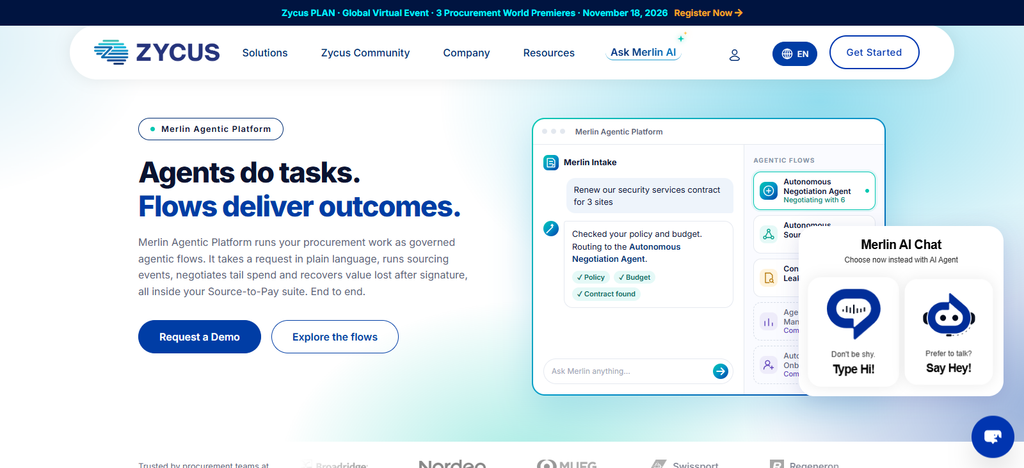
The platform automates workflows from intake to contract to PO, and links supplier performance to risk data for sourcing decisions. Zycus delivers supplier onboarding, master-data synchronization and ongoing enrichment with risk, credit, ESG and compliance providers. With 1,121 APIs, an MCP server, and integrations to SAP, Oracle, Workday, Microsoft Dynamics, and other systems, it is built to scale across global enterprises. Pricing is based on enterprise subscriptions.
Where it’s strong: Zycus Merlin AI is focused on agentic procurement automation, with focused AI-driven capabilities that enable sourcing, purchasing, supplier management, spend intelligence and procurement workflows.
Where It Falls Short: Advanced AI functionality may require careful configuration, data preparation and workflow integration. Organizations should validate agent autonomy across individual procurement processes.
Best For:\ Enterprises that want to integrate agentic AI into procurement functions including sourcing, spend analysis, supplier management, purchasing and automate repetitive workflows.
Features You Will Love:
- Merlin AI purchase agents.
- Sourcing automation powered by AI.
- Analysis of intelligent spending.
- Supplier life cycle management.
- Automated purchasing workflows.
6. Zip
Zip is an AI-driven procurement orchestration platform that is the front door for purchase requests, connecting employees, procurement teams, vendors and existing systems. Rather than replacing every procurement tool, it orchestrates intake, approvals, vendor selection, PO creation and downstream execution across ERP, P2P, CLM, GRC and ITSM systems.
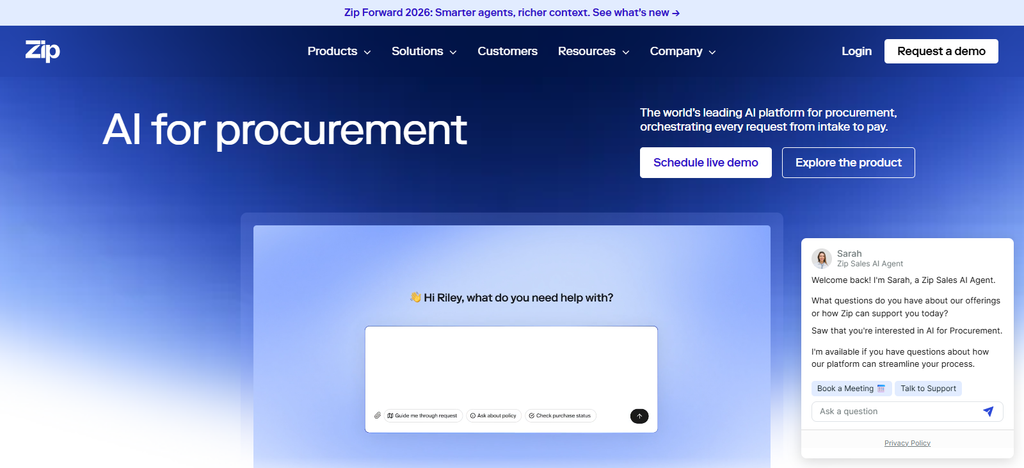
It has AI that lets you guide request intake, identify vendors, check status, access spend data and set up integrations, including connections to MCP-compatible AI tools like Claude and ChatGPT. Zip consolidates data on vendors, contracts, POs, invoices and approvals into one auditable source of truth.
It scales with 100+ integrations, low-code App Studio, APIs, flat-file imports, and a Marketplace of prebuilt templates. Pricing is subscription based and typically scoped by users, integrations and deployment needs.
Where it shines: Zip streamlines procurement intake by consolidating purchasing requests, automating approval routing, gathering business stakeholders, and orchestrating procurement workflows with AI-powered orchestration.
What It Doesn’t Have: Its key strength is procurement orchestration, not to replace every specialized source-to-pay function, so organizations might have to have additional systems for advanced procurement needs.
Best For: Growing businesses and enterprises looking for centralized procurement intake, simplified purchase approvals, automated request routing, and better collaboration between finance and procurement teams.
Key Features:
- AI-driven procurement intake.
- Automated approval workflow.
- Processing of purchase requests.
- Orchestration of Procurement.
- Integrations with enterprise systems.
7. Fairmarkit
Fairmarkit is a tail-spend and sourcing-automation platform that makes repetitive, lower-value purchases faster, more compliant and more competitive. It uses AI to identify purchase requests that are suitable for competitive quoting, suggest suppliers, prepare RFQs, compare quotes and support award decisions, helping procurement teams reduce cycle time and capture savings on tail spend.
Its workflow automation directs requests, collects supplier responses, normalizes evaluations and generates an audit trail from requisition to award. Supplier management capabilities include supplier discovery, onboarding support, qualification and performance visibility to participating vendors.
Fairmarkit is designed to complement your existing ERP and P2P systems rather than replace them, which makes it perfect for organizations looking for incremental automation at scale. The pricing is typically subscription based and is customized based on the spend volume and modules.
Where It’s Good At: Fairmarkit is an AI-driven sourcing automation solution that helps procurement teams discover suppliers, create RFQs, compare quotes and manage repetitive sourcing tasks more efficiently.
What It Sucks At: Its dedicated sourcing focus may necessitate the use of complementary procurement systems to facilitate broader source-to-pay functions, including complete contract management, invoice processing, and financial administration.
Best For: Procurement teams looking to automate tactical sourcing, improve tail-spend management, increase supplier participation, and reduce the manual effort involved in competitive purchasing.
Features
- Sourcing automation powered by AI.
- Automatic RFQ generation.
- Identification and recommendation of suppliers.
- Comparison of quotations.
- Tail spend management.
8. Keelvar’s
Keelvar is an AI-native sourcing-optimization platform that allows procurement teams to design, run and evaluate complex sourcing events beyond traditional reverse auctions. Its optimization engine considers multiple award scenarios, constraints, capacity limits, supplier preferences and business rules to recommend sourcing strategies that balance cost, risk, sustainability and supply resilience.

AI and automation help with event setup, bid analysis, scenario comparison and award recommendations, and workflows handle RFx creation, supplier participation, evaluation and decision documentation. Supplier management deals with bid participation, capability data and performance inputs to optimization models.
Keelvar scales especially well for direct materials, logistics, and complex categories with many suppliers and constraints. It integrates with procurement platforms like Zip and enterprise systems via APIs; pricing is negotiated on an enterprise-wide basis.
Strongest Where: Keelvar’s AI-led sourcing orchestration, optimization, supplier engagement and e-auctions provide advanced sourcing automation to guide complex procurement decisions and competitive bidding processes.
Where It Misses: Specialized sourcing capabilities may need to be integrated into wider procurement systems and complex sourcing scenarios may involve the configuration and expertise of experienced procurement professionals.
Best For: Large procurement teams for complex sourcing events, competitive supplier bidding, strategic negotiations and cost optimization across categories and multiple purchasing requirements.
Important Components
- AI-driven sourcing orchestration.
- Automated RFQ processing.
- Sophisticated sourcing optimization.
- e-reverse auctions.
- Automated supplier engagement.
9. Contract
Pactum is an AI-driven autonomous negotiation platform that allows companies to negotiate commercial terms with suppliers at scale through conversational AI. It is often used for tail spend, renewals, indirect categories and high volume supplier negotiations where human buyers can’t negotiate each deal one by one.

Its AI agents negotiate based on a set of rules or policies, propose alternatives, assess supplier responses and escalate exceptions or final agreements back to the procurement teams. Workflow Automation involves initiating negotiations, engaging suppliers, managing counteroffers, routing approvals, and recording outcomes.
Supplier management is about the terms, preferences, risk rules and negotiation history that is specific to a supplier. Pactum is built to scale across thousands of suppliers and integrates with procurement, ERP, contract and sourcing systems via APIs. Typically enterprise subscription based pricing and negotiated scope of deployment.
Where It’s Strong: Pactum is a leader in autonomous supplier negotiations, employing AI agents to negotiate in a structured manner, manage supplier relationships, and secure win-win commercial agreements.
Where It’s Lacking: When the focus is on supplier negotiations, companies may need to turn to other procurement platforms for purchase approvals, invoice management, sourcing administration and broader spend analytics.
Best For:\ Enterprises seeking automation of repetitive supplier negotiations, better outcomes for commercial agreements and the management of large supplier networks without the need for manual negotiation management.
Important Features:
- AI negotiation that drives itself.
- Automating supplier communication.
- Optimization of negotiation strategy.
- Management of supplier contracts.
- Analytics for negotiation performance
10. Level Path
Levelpath is an AI-native procurement platform that modernizes intake, purchasing, supplier management and procurement operations with a consumer-grade user experience. It brings together agentic AI, workflow automation and a connected data layer to guide employees through purchase requests, routing approvals, enforcing policy and coordinating execution across procurement and finance systems.

Its AI capabilities help teams reduce the amount of manual intake and approval work by supporting request classification, policy guidance, supplier recommendations, document understanding and operational insights. Supplier management involves the onboarding of vendors, data maintenance, workflows for risk and compliance, and insight into performance.
Levelpath is built for organizations that want a modern procurement front end that scales with existing ERP, P2P, contract, and spend systems through APIs and integrations. Enterprise subscription pricing based on the scope of the deployment.
Where It Shines: Levelpath delivers AI-native procurement management that simplifies procurement with intelligent request intake, workflow orchestration, sourcing support, and purchase coordination.
It’s weaker where: Capabilities and integrations should be evaluated against complex enterprise requirements, including specialized sourcing, global supplier management, and advanced procurement processes.
Best For: Businesses looking for modern AI-driven procurement workflows, consolidated purchase requests, streamlined approvals, and improved collaboration between procurement teams and internal stakeholders.
Main Features:
- Procurement management AI-native.
- Smart Procurement Intake.
- Automatic approval workflows
- Procurement and buying coordination.
- Orchestration of procurement workflows.
How to Choose the Best AI Agent for Procurement Automation?
Identify Procurement Requirements: Review your purchasing processes, sourcing needs, supplier management activities and approval workflows to identify which procurement tasks need to be automated and where AI agents can help improve efficiency.
Evaluate AI Capabilities: Determine if the platform offers intelligent automation, generative AI, predictive analytics, autonomous decision-making, and AI-powered recommendations to enable accurate procurement operations and intelligent purchasing decisions.
Supplier Management Review: Select an AI agent that can help you identify, onboard, rate and assess risk, and communicate with suppliers, to enhance supplier relationships and optimize vendor management processes.
Workflow Automation Review: Look at options to automate purchase requests, purchase orders, approval routing, invoice processing, contract management and sourcing workflows to reduce repetitive administrative tasks.
Look for Integration: Make sure the platform integrates with your existing ERP systems, accounting software, financial applications and procurement tools to keep data consistent and business operations connected.
Check Security and Compliance: Look at data protection, control of access, audit logs, encryption, and compliance features to safeguard sensitive supplier data and guaranty secure procurement processes.
Consider Pricing and Scalability: Look at subscription fees, implementation costs, customization needs, and scalability features to make sure the AI procurement agent fits your budget and business growth plans.
Evaluation of Reporting and Analytics: Seek a platform that can provide spend analysis, procurement dashboards, supplier performance reports, purchasing insights and cost-saving recommendations so you can make informed decisions and continuously improve operations.
Conclusion
Procurement automation AI agents are transforming how businesses handle purchasing, sourcing, supplier relationships and spending activities. Procurement platforms like Coupa, SAP Ariba, Ivalua, GEP SMART, Zycus Merlin AI, Zip, Fairmarkit, Keelvar, Pactum, and Levelpath can provide a range of capabilities to help streamline procurement workflows.
Solutions range from automated supplier negotiations, intelligent spend analysis and purchase approvals to help organizations improve efficiency and reduce manual workloads. The choice of platform depends on business needs, AI capabilities, integration possibilities, security, cost and scalability. The best solution can improve procurement operations and facilitate smarter purchasing decisions.
FAQ
What are the best AI agents for procurement automation in 2026?
Some of the best AI agents include Coupa, SAP Ariba, Ivalua, GEP SMART, Zycus Merlin AI, Zip, Fairmarkit, Keelvar, Pactum, and Levelpath.
How do AI agents help automate procurement processes?
AI agents automate purchasing requests, supplier discovery, sourcing, quotation comparisons, purchase approvals, invoice processing, and supplier communication, reducing repetitive manual activities.
Can AI agents manage supplier relationships?
Yes, AI agents can support supplier discovery, onboarding, performance evaluation, risk assessment, communication, and supplier information management.
Can AI procurement agents reduce purchasing costs?
Yes, they can identify spending patterns, compare supplier quotations, highlight savings opportunities, automate sourcing activities, and improve purchasing decisions.
What procurement tasks can AI agents automate?
They can automate purchase requests, purchase orders, approval routing, RFQ creation, supplier evaluations, contract workflows, invoice processing, and spend analysis.