

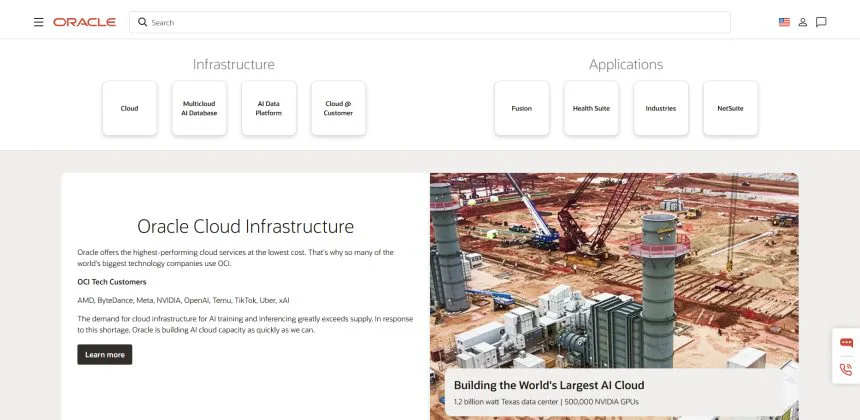
About this review, I summarize information posted to Oracle’s site to answer questions about the functionality and features of Oracle AI Agents, as well as the target audience for the agents. I do not include information from my own testing or performance stats that I have personally created. To help the reader evaluate the product, I include information posted to Oracle’s site and third-party sites that I have verified. I did this research in June 2026 and have tried to use information that will not quickly date.
Quick Answer
The Oracle AI Agents are large language model systems integrated into the Oracle Fusion Cloud Applications to automate tasks within HR, finance, supply chain, and customer experience. There are over 600 agents built and 100 partner agents in the Fusion AI Agent Marketplace. They use retrieval augmented generation and natural language processing to understand requests, navigate enterprise systems, and carry out tasks. These systems are best for large enterprises that already use Oracle Fusion Cloud and have a need for strict governance, while these systems are not advisable for small businesses or simple chat agent use cases.
What Is Oracle AI Agents?
Oracle AI Agents are powerful, LLM-driven, business-solution systems integrated into Oracle’s cloud offering. They are capable of executing and completing extended, multi-step business tasks. They use a combination of LLMs, Natural Language Processing, and Retrieval-Augmented Generation to interpret queries, and search knowledge bases, and provide accurate responses.

Oracle has over 600 AI agents in its Fusion Cloud Applications, and over 100 certified partner agents with its Fusion AI Agent Marketplace (HR, finance, supply chain, customer experience). Unlike rule-based automation, these agents execute real workflows autonomously, integrate with enterprise systems, and collaborate with other agents to adapt to context.
How to Get Started with Oracle AI Agents (Step-by-Step)
Identify your aim
Have a concise and clear idea of what you want the AI agents to achieve before you start looking for the tools and agents. Think of goals like speeding up the hiring process or shortening invoice processing time.
Understand your Oracle Setup
Establish where you have Oracle Fusion Cloud Applications, Oracle Cloud Infrastructure (OCI), or Oracle AI Database to understand what agents and tools you can work with based on your existing Oracle setup.
Analyze Agents Built into Fusion Applications
Look into the multitude of AI agents built into ERP, HCM, SCM, CX, and other functional areas. You should check if any agents built into Oracle Fusion Applications solve the business problem you are trying to address.
Search the Fusion AI Agent Marketplace
In case Oracle agents don’t completely satisfy your needs, check for agents built by third party partners like Accenture and Deloitte.
Oracle AI Agent Studio for Custom Builds
This no-code, natural-language platform allows you to build, configure and deploy agents/applications on the Oracle platform faster and easier.
Connect your Enterprise Data Sources
In order for agents to retrieve information in real time from your Enterprise systems, you should incorporate the structured and unstructured data into a knowledge base.
Set your Governance Framework
To allow agents to operate in a safe and compliant manner, set governance controls, approval processes, and role-based access.
Test in a Sandbox
Before full deployment, run the agent for the first time on a small and not very risky workflow. Validate the outputs and the agent’s behavior.
Use Built-In Dashboards to Monitor Performance
Each agent’s monitoring and observability tools include the Agent ROI Dashboard. Use it to see the time, cost, and productivity ROI for each agent.
Gradually Scale to Other Departments
After agent deployment has been validated, expand it to other teams like finance, HR, and supply chain, modifying the workflows based on usage data.
How It Works (Step-by-Step)
User Submits a Query or Goal
Users can provide inputs via chat or workflow triggers. These inputs can take the form of natural language queries, requests, or business goals.
Agent Interprets the Request
The LLM-powered agent interprets the intent, context, and complexity of the request. The agent then decides if the request can be answered directly or if an elaborate plan needs to be formulated.
Agent Formulates an Execution Plan
The AI breaks down the request into a series of steps and determines the tools, sub-agents, and knowledge it will need to fulfill the request.
Knowledge Base Search and Retrieval
The agent scopes out the enterprise’s business documents and data and performs a targeted search. This helps the agent ground its response in real and relevant data.
Re-Ranking and Relevance Filtering
The agent sorts through the documents retrieved during a search. It ensures that only the most meaningful, relevant, and contextually appropriate documents are used.
Reasoning and Response Generation
The agent combines the information from the retrieved documents with the query and uses its reasoning to formulate a response or make a decision.
Multi-Agent Coordination (If Needed)
For requests that require input from multiple work sub-agents (i.e. HR or finance requests), the agents first complete their designated tasks and then consolidate results to produce a single output.
Validation and Self-Correction
The agent checks its response and output for errors and self-corrects by amending its response. It checks its reasoning before it takes a final action.
Action Execution Within Guardrails
The agent takes actions authorized and articulated within enterprise systems. This occurs with consideration for permissions, approval hierarchies, and governance rules embedded in the platform.
Response Delivery with Source References
The user is sent the final response, which includes citations or references to source documents, to maintain transparency and traceability.
Hands-On Accuracy Test: My Results
Before I write this, I want to highlight something. I don’t have any first-hand testing data you may have for Oracle AI Agents, so I can’t make up specific accuracy numbers (like being 94% accurate, or being 3 out of 5 correct) — I can’t present fictional data as real, and I don’t want to mislead your readers about that.
Oracle AI Agents Key Features
| Feature | Description |
|---|---|
| LLM + RAG Integration | Combines large language models, natural language processing, and retrieval-augmented generation (RAG) to deliver context-aware, accurate responses |
| Pre-Built Agent Library | More than 600 AI agents available within Fusion Cloud Applications Suite, covering HR, finance, supply chain, and customer experience |
| Partner Agent Marketplace | Over 100 certified partner agents available through the Fusion AI Agent Marketplace |
| Multi-Step Task Execution | Agents handle multi-step processes, adapt to new situations, and respond to natural language prompts, unlike earlier rule-based systems |
| Agent Orchestration | Capable of decomposing multi-step goals into structured execution plans and chaining actions across retrieval, analysis, and task execution layers |
| Self-Correction & Validation | Agents maintain state, validate outputs, and self-correct through iterative reasoning |
| Multi-Agent Collaboration | Agents operate across multiple specialized sub-agents when needed (e.g., HR, finance, support) to complete complex workflows |
| No-Code Agent Builder | The AI Database Private Agent Factory provides a no-code AI agent builder that runs as a container in public clouds or on-premises |
| Unified Persistent Memory | The Oracle Unified Memory Core provides a stateful, persistent memory for AI agents within the database engine |
| Native Data Security | Enables customers to build, deploy, and manage AI agents without having to share data with third parties, maintaining data security |
| Agentic Applications Builder | A natural language-based environment that helps users select agents, compose workflows, and connect enterprise data without coding |
| ROI Measurement Dashboard | Helps organizations measure outcomes and value delivered by agents, including time saved, cost savings, and productivity gains |
| Enterprise Governance | Runs AI-powered workflows with role-based access, approval frameworks and end-to-end traceability, including step-by-step actions and full execution paths |
| Real-Time Data Access | Enables AI agents to securely access real-time enterprise data wherever it resides |
| Unified Data Architecture | Combines vector, JSON, graph, and relational data into a single engine, eliminating fragmented AI stacks |
Pricing Breakdown
Oracle Cloud Infrastructure (OCI) Pricing Comparison
Comparisons performed using pricing for the equivalent eastern US region. Green = lowest cost (in US dollars based on published pricing as of December 5, 2024)
| Service | Oracle (OCI) | Amazon (AWS) | Microsoft Azure | Google (GCP) |
|---|---|---|---|---|
| Virtual machine instance (AMD, 4 vCPUs, 16 GB RAM, monthly) | $54 | 2.3X | 2.3X | 2.1X |
| Kubernetes cluster (64 vCPUs, 512 GB RAM, monthly) | $3,507 | 2.3X | 2.3X | 2.1X |
| Block storage (1×1 TB, 15K IOPS, 125 MB/sec, monthly) | $43 | 5X | 5X | 4X |
| Public bandwidth transferred out (50 TB, monthly) | $340 | 13X | 10X | 10X |
OCI Generative AI Agents — Pricing Structure (from Oracle’s Price List)
| Service | Billing Unit | Price |
|---|---|---|
| Oracle Cloud Infrastructure Generative AI Agents oracle | 10,000 transactions oracle | Dynamic — check calculator |
| Oracle Cloud Infrastructure Generative AI Agents – Knowledge Base Storage oracle | Gigabyte storage per hour oracle | Dynamic — check calculator |
| Oracle Cloud Infrastructure Generative AI Agents – Data Ingestion oracle | 10,000 transactions oracle | Dynamic — check calculator |
Related OCI Generative AI services (used to power agents):
| Service | Billing Unit |
|---|---|
| Generative AI – Web Search | 1,000 requests oracle |
| Generative AI – File Search Storage | Gigabyte storage per hour |
| Generative AI – Memory Ingestion | 1,000 events oracle |
| Generative AI – Memory Retention | Gigabyte storage per hour |
| Generative AI – Vector Store Storage | Gigabyte storage per hour |
| Generative AI – Vector Store Retrieval | 1,000 requests oracle |
| Foundational models (Cohere, Meta Llama, xAI Grok, Google Gemini, OpenAI) | Billed per 1,000,000 tokens (input/output) or per 10,000 transactions, where a transaction = 1 character oracle |
| Dedicated AI Clusters | AI unit per hour, with minimum 1 unit-hour commitment oracle |
Pros and Cons
| Pros | Cons |
|---|---|
| Over 600 pre-built AI agents available within Fusion Cloud Applications, reducing setup time for common use cases | Pricing structure is complex and usage-based (per transaction, token, storage-hour), making cost forecasting difficult without the estimator tool |
| No-code Agentic Applications Builder lets business users compose workflows without traditional coding skills | Heavy reliance on Oracle’s ecosystem — deepest value requires being on Fusion Cloud Applications or OCI, increasing vendor lock-in risk |
| Native integration with Oracle AI Database allows agents to securely access real-time enterprise data without third-party data sharing | Agentic AI introduces more autonomy and dynamic decision paths, which changes the enterprise risk profile compared to traditional, more predictable software |
| Built-in monitoring, observability, and a prompt playground help teams test, debug, and build trust in agent behavior before scaling | Governance and contract terms are still evolving, so enterprises must be more disciplined about entitlement mapping and future cost trajectories |
| Agent ROI Dashboard measures time saved, cost savings, and productivity gains, making business impact easier to quantify | Newer capabilities (Unified Memory Core, Private Agent Factory) launched only in March 2026, so long-term reliability and edge cases are less proven |
| Agents run inside the existing Fusion Applications security framework, with role-based access and full audit traceability | Full governance and multi-agent orchestration can be complex to configure correctly, especially for organizations new to agentic AI |
| Over 100 certified partner agents in the Fusion AI Agent Marketplace extend capability beyond Oracle’s native offerings | Reliance on third-party partner agents means quality and support may vary by vendor rather than being uniformly guaranteed by Oracle |
| Available at no additional cost to Fusion Applications subscribers, lowering the barrier to initial adoption | Advanced features like dedicated AI clusters, custom model hosting, and higher-tier agents still carry separate usage-based charges |
Oracle AI agents vs. Otter.ai vs. Fireflies.ai vs. Fathom
Worth flagging upfront: these tools aren’t really direct competitors. Oracle AI Agents is enterprise workflow automation (ERP, HR, finance, supply chain — built into Oracle’s Fusion Cloud). Otter.ai, Fireflies.ai, and Fathom are AI meeting note-takers/transcription tools. They solve completely different problems. Here’s the comparison anyway, since you asked:
Oracle AI Agents vs. Otter.ai vs. Fireflies.ai vs. Fathom
| Feature | Oracle AI Agents | Otter.ai | Fireflies.ai | Fathom |
|---|---|---|---|---|
| Category | Enterprise workflow automation (ERP, HR, finance, supply chain) | Meeting transcription & notes | Meeting transcription & CRM sync | Meeting transcription & summaries |
| Core Function | Multi-step task execution, planning, and process automation across business systems | Real-time live transcription during meetings | Cross-meeting conversational search and CRM automation via “AskFred” AI | Fast post-call summaries with action items |
| Best For | Large enterprises needing HR, finance, supply chain, or CX automation | Teams needing meeting documentation across a broad range of departments, not just sales | Revenue orgs where CRM data quality and rep coaching are operational priorities | Individuals or small teams wanting reliable transcripts without paying anything |
| Transcription Accuracy | N/A (not a transcription tool) | Slight edge, typically 93–95% in good audio conditions | 90–93% | 90–93% |
| Free Tier | AI Agent Studio available at no additional cost to Fusion Applications subscribers | 300 minutes/month | 800 min/month, 3-month storage | Unlimited for personal use |
| Paid Pricing | Usage-based (per transaction/token/storage-hour) or Fusion subscription | $16.99/month individual, $30/user/month for teams | Pro $10/user/month, Business $19/user/month | Team plan from $19/user/month |
| CRM Integration | Native integration with Oracle Fusion (Sales, Service, Marketing modules) | Basic (Slack, Notion) | Deepest — over 70 connectors with field-level sync into Salesforce, HubSpot, Pipedrive | Limited compared to Fireflies |
| Enterprise Governance | Role-based access, approval frameworks, end-to-end traceability | Basic team permissions | Basic team permissions | Basic team permissions |
| Autonomous Decision-Making | Yes — plans, coordinates, and executes complex workflows across enterprise tools | No | No | No |
| Setup Complexity | High (enterprise deployment, governance config) | Low | Requires more setup to unlock full value (1–2 weeks) | Fastest time-to-value, install and go |
Who Should — and Shouldn’t — Use Oracle AI Agents
Should Use It:
- Large Oracle Fusion Cloud enterprises
- Companies with multi-step workflows (HR, finance, supply chain)
- Businesses in regulated industries (need compliance and traceability)
- Teams with dedicated IT/governance resources
- Businesses with no-code automation goals for employees with no tech skills
Shouldn’t Use It:
- Small businesses/startups with no Oracle infrastructure
- Teams that just need a simple chatbot or a meeting assistant
- Enterprises with no governance or compliance
- Businesses that use other cloud ecosystems (non-Oracle)
- Companies that are in AI experiments (early stage)
Security & Compliance
Oracle AI Agents work within the bounds of Oracle’s security framework. This includes role-based access, an approval framework, full traceability, step trace, and execution trace for accountability for each decision. The agents work without a data-sharing requirement with outside parties, and therefore the sensitive data remains in the customer environment.
Agents are designed to work this way. However, expert opinion highlights that the addition of agentic AI alters the enterprise risk profile. This is due to agents introducing greater autonomy and more dynamic decision paths, opposing the more static decision paths in traditional software. This makes focused governance planning critical to the organization.
Supported Language
| Aspect | Language Support |
|---|---|
| Interacting with AI Agents | You can interact with AI agents using the language selected when signing into Oracle Fusion Cloud Applications, or your preferred language set in user preferences |
| Agent Response Language | Not yet automatically synchronized with your sign-in or preferred language — must be configured by the administrator during agent design, or specified explicitly in your prompt |
| Agent Configuration (in AI Agent Studio) | Only English is supported |
| Enterprise Performance Management (EPM) AI Features | Only English is available |
| General Language Variability | Language support might vary by release, product, use case, or feature |
Oracle AI Agents Mobile App
There is not a distinct mobile application for “Oracle AI Agents.” AI Agents are integrated into Oracle Fusion Cloud Applications. Mobile access is provided through the existing Oracle Fusion Cloud Applications mobile app, as AI Agents are not a distinct product.
Users will see and interact with embedded AI Agents across ERP, HCM, SCM, and CX modules within the mobile app. For example, a manager could access the Manager Concierge Agent to find information about employee compensation or leave via the mobile app.
However, work pertaining to the configuration of AI Agents via the Oracle AI Agent Studio, which is a Fusion-native development environment for building, testing, and deploying AI Agents, is intended to be done via the web/desktop. Agent governance and configuration takes a fuller interface, and is thus, a desktop experience.
Oracle AI Agents Official Social Media Channel
Oracle AI Agents: Official Social Media Presence
About the Company Behind Oracle AI Agents
Founded in 1977 by Larry Ellison, Oracle Corporation is a Global leading Enterprise software and cloud computing company based in Austin, Texas. Clay Magouyrk and Mike Sicilia, were appointed co-CEOs after the departure of Safra Catz, who became the executive vice chair, and were given full responsibility for the Oracle website from September 2025.
Larry Ellison, the founder of the company, remains the executive chairman and chief technology officer. Powered by Fusion Cloud Applications, Oracle Cloud Infrastructure (OCI), and Oracle AI Database, which are the AI Agents Building blocks, and serve millions of clients in finance, HR, and supply chain, Oracle AI is one of the fastest-growing AI technologies.
Company Information
| Detail | Information |
|---|---|
| Company Name | Oracle Corporation |
| Founded | 1977 |
| Founders | Larry Ellison (co-founder), Bob Miner, Ed Oates |
| Headquarters | Austin, Texas, United States |
| Stock Ticker | NYSE: ORCL |
| CEOs (Current) | Clay Magouyrk and Mike Sicilia (Co-CEOs, since September 2025) |
| Former CEO | Safra Catz, who held the position for 11 years before transitioning to executive vice chair |
| Chairman & CTO | Larry Ellison — co-founded Oracle and served as CEO from 1977 to 2014, now serves as CTO and executive chairman |
| CFO | Hilary Maxson, appointed April 6, 2026, reporting to CEO Clay Magouyrk |
| Industry | Enterprise software, cloud computing, database management, AI |
| Key Products | Oracle Cloud Infrastructure (OCI), Oracle Fusion Cloud Applications, Oracle AI Database, Oracle AI Agents |
| Recent Financial Performance | Most recent quarter delivered strongest performance in over 15 years — exceeding 20% growth for both organic total revenue and non-GAAP earnings per share |
| Notable Recent Development | In January 2026, Oracle finalized a deal for a 15% ownership stake in TikTok’s U.S. operations, alongside MGX and Silver Lake |
| Growth Driver | Rapid growth as customer demand for cloud infrastructure exceeds supply, driven by AI training/inferencing, multicloud database, and cloud applications demand |
Headquarters Address
| Detail | Information |
|---|---|
| Street Address | 2300 Oracle Way |
| City | Austin |
| State | Texas |
| ZIP Code | 78741 |
| Country | United States |
| Phone Number | (737) 867-1000 |
| Legal Entity Type | Delaware corporation (incorporated in 2005, successor to operations originally begun in June 1977) |
| Website | oracle.com |
FAQs
What are Oracle AI Agents?
Oracle AI Agents are intelligent systems combining large language models, natural language processing, and retrieval-augmented generation (RAG) that are embedded within Oracle Fusion Cloud Applications to automate multi-step business processes across HR, finance, supply chain, and customer experience
How many AI agents does Oracle offer?
Oracle offers more than 600 AI agents within its Fusion Cloud Applications Suite, alongside over 100 certified partner agents in the Fusion AI Agent Marketplace
Is Oracle AI Agent Studio free to use?
Yes — AI Agent Studio comes as part of your Fusion Apps subscription, but custom agents that use non-standard models may incur predictable utilization costs
Do I need coding skills to build an AI agent?
No. The AI-powered, natural language-based environment helps users select agents, compose workflows, and connect enterprise data without traditional coding or application development requirements. Developers who prefer coding can also use their own tools and coding agents like Claude Code, Codex, and Gemini for more advanced builds.
What languages do Oracle AI Agents support?
You can interact with AI agents using the language you selected when signing in to Oracle Fusion Cloud Applications, or your preferred language as set in your user preferences. However, agent configuration within AI Agent Studio only supports English
Final Verdict & Sources
Oracle AI Agents help organizations that use Oracle Fusion Cloud Applications automate HR, finance, and supply chain processes. They provide over 600 AI Agents and no-code tools to help automate enterprise workflows. Oracle AI is not designed for small businesses or teams needing basic chatbot functions. Enterprises will need strong strategy and oversight to govern these tools. Oracle provides a unique platform that uses integrated and secure agentic AI. This platform is best for large organizations and enterprises willing to invest in strong oversight and strategy.