
In this article, I will be discussing the Best AI Agents for RFP Response Automation that help businesses to streamline proposal management, automate questionnaire completion, and create accurate responses faster. As organizations process more and more requests for proposals, they struggle with repetitive questions and large documentation requirements.
AI-enabled tools such as Responsive, Arphie, Inventive AI and AutoRFP.ai help streamline these processes, improve team productivity, organize company knowledge, and reduce manual work, making rfp management more efficient.
Quick Comparison Table
| AI RFP Agent | Best For | Key AI Capabilities |
|---|---|---|
| Responsive | Large enterprises | AI response generation, content discovery, workflow automation, answer quality scoring |
| Arphie | Fast-growing businesses | AI answer generation, source citations, confidence scoring, knowledge retrieval |
| Inventive AI | Sales and proposal teams | AI agents, connected knowledge sources, automated questionnaire responses, answer generation |
| AutoRFP.ai | High-volume RFP responses | AI drafting, source-grounded answers, citations, response quality checks |
| 1up | Small and mid-sized businesses | AI knowledge retrieval, automated answers, document-based response generation |
| SiftHub | Presales and revenue teams | AI-powered RFP responses, verified knowledge retrieval, deal-context intelligence |
| AutogenAI | Complex proposals and tenders | AI proposal writing, content research, narrative generation, document review |
| Conveyor | Security questionnaires and RFPs | AI-generated questionnaire answers, knowledge management, security response automation |
| Upland Qvidian | Enterprise proposal management | AI-assisted content management, proposal automation, document assembly, response reuse |
1. Responsive
Responsive (formerly RFPIO) is an enterprise platform for managing RFP responses, security questionnaires and proposal workflows. Prices are custom, with editions starting at around $5,000 per year for five users. Higher tiers add automation, governance, and analytics. Its AI uses specialized agents for document import, answer generation and content scoring to create grounded drafts with source citations.

Teams integrate sources such as SharePoint, Salesforce, Slack and Microsoft 365, and maintain a centralized content library. Accuracy is supported by approved content, traceability to sources and review controls. Workflow automation covers intake, assignments, collaboration, approvals and reporting. Responsive has 75+ native integrations, making it a good fit for large, multi-team enterprise programs.
Where it is strong
Responsive is great at handling enterprise RFPs, with centralized content libraries, AI-assisted answer generation, collaboration tools and automated workflows to help teams complete complex questionnaires efficiently and consistently.
Where It Falls Short
It is feature-rich, and as such may require onboarding and setup that can be difficult for smaller teams to implement. Pricing transparency and advanced enterprise capabilities also can complicate initial purchasing decisions.
Best For:
Ideal for mid-market and large companies with high volumes of RFPs, security questionnaires and proposals that require structured collaboration, reusable knowledge and consistent responses.
Main Features
- AI generated responses.
- Centralized knowledge base.
- Automated RFP process.
- Teamwork and Review.
- Analytics and reporting of responses
2. Arphie
Arphie is an AI-native RFP and questionnaire automation platform that produces rapid, source-grounded first drafts. Pricing is by quote, and varies by users, project volume, AI entitlements, integrations, onboarding, and support. The platform imports Word and Excel questionnaires, determines their structure and drafts answers from connected knowledge sources. It integrates directly with Google Drive, SharePoint, Notion, Confluence, Seismic, Highspot, Salesforce and web content.

Arphie improves the accuracy of answers by displaying the exact past proposals, product documents and knowledge-base articles used for each response. Workflow automation involves questionnaire ingestion, drafting, collaboration, review and export. It works for teams that want transparent AI sourcing and flexible content integration.
Where It’s Healthy
Arphie is brilliant at AI-powered proposal automation, smart document understanding and knowledge retrieval. It helps sales teams quickly generate relevant answers, while cutting down on repetitive manual work.
Where it is not as strong
How well it works depends on how good the company knowledge that is available is. In teams with poorly organized documentation it might take some additional prep time to come up with reliable answers and consistent proposal results.
Best For
Ideal for sales, presales, and proposal teams that want AI-powered RFP automation, accelerated questionnaire completion, centralized organizational knowledge and a lighter admin workload.
Major Features
- AI-generated responses to RFPs.
- Intelligent knowledge search.
- Understanding documents.
- Automatic filling of questionnaires.
- Check answers and collaborate
3. Inventive AI
Inventive AI is a usage-based RFP, RFI, DDQ and security questionnaire platform with unlimited users and no feature tiers. Pricing starts at $830 a month for annual billing, according to published prices, but another company page shows plans starting at $10,000 a year, so buyers should check current terms. Its AI utilizes the context of the buyer, deal, previous answers, product documentation and SME-approved content to respond with tailored, human-like answers to each question.
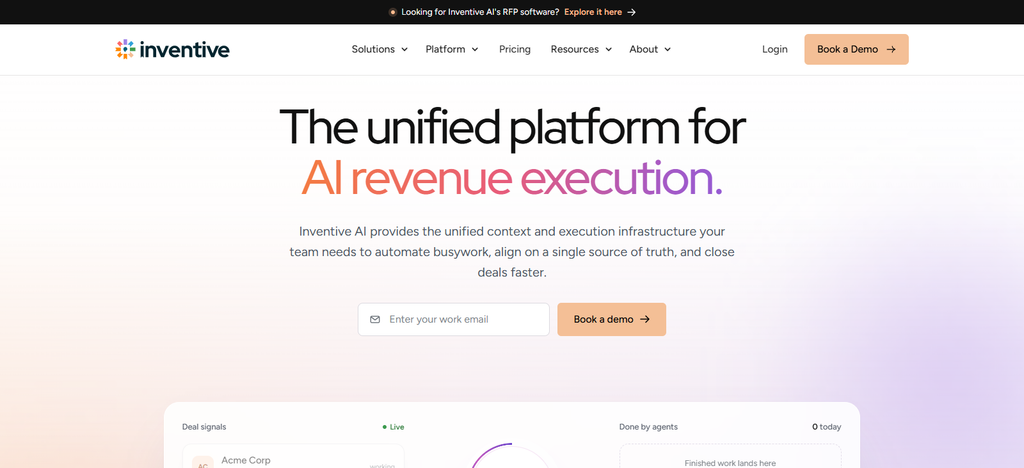
The Knowledge Hub pulls content from Google Drive, SharePoint, Confluence, Notion, and Salesforce, and automatically updates as the underlying content changes. We find that conflict detection and source-grounded generation improve accuracy. Workflow automation includes assignment, review, tracking, reporting and portal-based RFP responses.
Where It Is Effective
Inventive AI is about speeding up the response process to your RFPs. We use contextual AI, enterprise knowledge management, and automated answer generation to help your proposal teams be more productive and consistent in their responses.
Where it is less strong
Organizations may need time to organize knowledge sources and set up review processes. Even responses generated by AI still require human review, particularly on technical, contractual or compliance issues.
Best For
Best for enterprise sales and proposal teams who deal with complex RFPs, large questionnaires, and repetitive documentation that require faster responses backed by organizational knowledge.
Main Features
- AI-driven response generation.
- Management of knowledge in enterprise.
- Context-aware answer extraction.
- Automatic questionnaire processing.
- Proposal collaboration workflows.
4. AutoRFP.ai
AutoRFP.ai is an AI RFP platform with unlimited users at a flat rate. It specializes in fast first-draft generation and collaborative bid production. Scale is $899/month billed annually for 24 projects, Accelerate is $1,299/month billed annually for 50 projects and Enterprise is custom. All plans include unlimited users, SSO, support and 18+ integrations. Its response engine drafts in seconds, uses approved verbatim language as a default and learns organizational tone and structure.
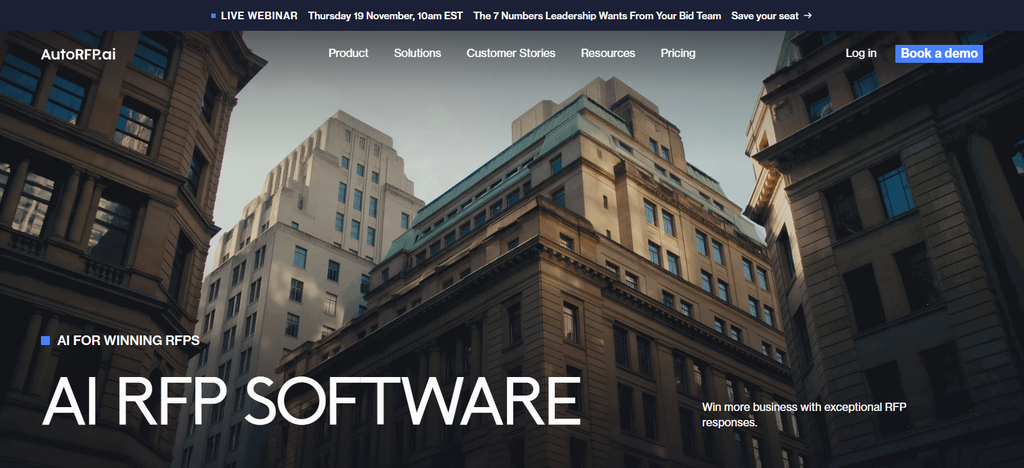
It integrates with SharePoint, Google Drive, OneDrive, Confluence, Notion, Slack, Teams, Salesforce and Zendesk/Intercom. Improved accuracy with approved-content reuse and source-aware generation. Workflow automation includes ownership, sequential review, co-editing, approval-gated saves, notifications, and Slack/Teams Q&A.
Where it is vigorous
AutoRFP.ai is all about automated questionnaire filling, AI-powered answering, and document processing. It assists proposal teams to reduce repetitive tasks and accelerate their overall RFP response workflows.
Where It’s Thinner
Detailed questionnaires may still need manual corrections and subject matter expertise. The quality of response depends on the available source documentation, organization of knowledge, and appropriate human review processes.
Best for:
Perfect for sales and proposal teams who regularly respond to RFPs, RFIs and security questionnaires and want to reduce manual response preparation with AI automation.
Main Features
- Automation of RFP completion.
- AI generated answers.
- Integration of knowledge base.
- Processing of questionnaire forms.
- Workflows for response management
5. 1 up
1up is a lightweight and user-friendly AI answer and questionnaire automation platform for sales, presales and proposals teams. There is a 14-day free trial and plans begin at $250/month. The published tiers are $50/month plus automation usage, $300/month unlimited-user plans, and usage-based pricing around $5 per 100 answers. Its AI builds answers from documents, URLs, previous RFPs and knowledge sources that are updated on an ongoing basis.

Teams can connect to Google Drive, Confluence, SharePoint, Notion and web URLs and update knowledge within seconds when sources change. Accuracy depends on connected source library and review workflows. Automation offers answer generation, collaboration, reviews, approvals, questionnaire automation, and messaging integrations with Slack, Teams and Google Chat.
Where it is strong
1up uses AI to answer questions based on the knowledge within your company, so sales teams can answer customer questions, security questionnaires, and RFPs without having to go through disparate documents over and over again.
Where it is not as strong
The quality of its output depends on the correctness of associated knowledge sources and documents. Some questions are highly specialized and may need additional input, verification and customization by experts before submission.
Best For:
Ideal for B2B sales, presales and security teams looking for faster answers to questionnaires, company knowledge at hand and less repetitive work in customer-facing processes.
Main Features
- Automated answering with AI.
- Centralized corporate knowledge.
- Sales enablement support.
- Support security questionnaire.
- Integrations of knowledge sources.
6. SiftHub.
SiftHub is an AI platform for revenue execution and RFP response, integrating proposal automation with broader deal context intelligence. Pricing is usage-based and customized, and scales with team size and deal volume, rather than with fixed public tiers. Its AI auto-fills RFPs and questionnaires across Excel, Word, Google Sheets, PDFs and browser-based procurement portals, generating responses that are traceable back to approved knowledge, past RFPs, product documentation and other sources.

SiftHub integrates with Salesforce, HubSpot, Slack, Teams, Google Drive, SharePoint, Highspot, Zendesk, Gong, Zoom, Clari, Avoma, Chorus, Jira and calendars. Source traceability and live deal context support accuracy. Automate workflows for response generation, collaboration, translation, and deal orchestration across the GTM stack.
Where It Is Most Powerful
SiftHub helps revenue teams discover knowledge with AI, prepare responses for customers, and simplify complex sales processes with sales enablement and proposal automation.
Where It Falls Short
Teams whose documentation is scattered may need more knowledge organization. Its broader sales enablement capabilities may also require configuration to fit specific proposal and questionnaire workflows.
Best For
Great for B2B revenue, presales and proposal teams wanting centralized knowledge discovery, faster RFP responses and improved sales information access.
Main Features
- AI for Knowledge Discovery.
- RFP responses automated.
- Sales Enablement Intelligence
- Knowledge management of enterprises.
- Contextual answer generation.
7. Autogen
AutogenAI is a cloud-based AI writing and bid management platform for RFPs, proposals, grants and tender responses. Pricing is quote-only, usually seat- and usage-based, so organizations will need to request a tailored proposal. The platform uses RFP outlines and project inputs to generate the first draft of content, creates compliant proposal outlines, performs real-time compliance checks, and pulls approved content from a central content library.

The knowledge base enables document storage, content reuse from previous work and library management. Compliance checks, content governance, reviewer workflows improve accuracy. Automation involves workflows for document generation, review, storage, and bid management. It integrates with Microsoft Copilot, Word, SharePoint, Microsoft Project Server and Zapier, making it a good fit for Microsoft-centric proposal teams.
Where it is strong
AutogenAI specializes in AI-enabled bid and proposal writing to help organizations produce structured responses, enhance content quality and manage complex tender submissions more efficiently.
Where It Falls Short
Its capabilities are particularly geared to bid and proposal writing and not every broader sales questionnaire workflow. Strategic positioning and final reviews still require human expertise.
Best For
Best for bid managers, proposal writers, and organizations responding to government tenders and competitive procurements, as well as complex business opportunities that require detailed submissions.
Main Features
- Bid writing assisted by AI.
- Create material for proposal.
- Management of knowledge.
- Help with responding to bids.
- Collaborative Document Development
8. Conveyer
Conveyor is an AI platform for trust, security reviews and RFP responses that combines questionnaire automation with a customer Trust Center. Pricing is usage-based, no per-user fees, no integration charges. Public plans include a free Trust Center option and a Business plan starting around $9,600 annually, while Enterprise is custom. ConveyorAI generates answers from curated Q&As, documents, previous answers, and external sources, and includes citations and links for each generated answer.

It links to Trust Center content, company websites, support sites, Google Drive, SharePoint, Confluence, Notion, Salesforce, Slack, Teams, DocuSign, Jira, Zendesk, and HubSpot. Citations, reusable human edits and source-linked evidence ensure accuracy. Automation includes auto-mapping, intake, drafting, review and one-click export of documents.
Where it’s Powerful
Conveyor is great at automating security questionnaires, managing trust, and using AI to help answer questions. It helps security and sales teams respond to customer assessments and stay organized with compliance information.
Where it is weaker
Its greatest strengths are in security reviews and trust workflows, not all types of commercial RFP. Expert verification is needed for complex responses.
Suitable For
Great for SaaS companies, security teams, and sales organizations dealing with a lot of security questionnaires, vendor assessments, and customer due diligence requests.
Main Features
- Security questionnaires powered by AI.
- Automated feedback to assessments.
- Trust management centralized.
- Handling of security documentation.
- Customer-facing trust workflows.
9. Upland Qvidian
Upland Qvidian is a proven enterprise proposal and response management platform for organizations that demand structured content governance and mature workflow controls. It doesn’t publish pricing; reports show quote-based, per-user annual licensing starting at around $1,000 per user per year with a 25-user minimum, plus implementation and AI-add-on costs. Qvidian offers automatic answering, AI generation and revision, content libraries, project management and collaboration.

It has a knowledge base that aggregates approved proposal content that can be reused across responses. Accuracy is strengthened by: controlled content libraries, review processes and established proposal-governance practices. Workflow automation includes project templates, assignments, approvals and response tracking. It integrates with Office 365, Salesforce, Outlook, Chrome, Firefox, Microsoft Dynamics, CPQ systems and an open API.
Where is best
Upland Qvidian delivers proven proposal management, content automation and response libraries to enable enterprise teams to standardize documents, manage complex proposals and improve response consistency.
Where It Falls Short
The enterprise-oriented structure can be hard for smaller teams to implement. You may need dedicated resources and ongoing management to tailor, administer, and maintain content libraries.
Best For
Best for large enterprises, proposal management departments and organizations that handle high-volume RFPs, sales proposals and standardized business documents across multiple teams.
Essential Features
- Automate proposals.
- Content library centralized.
- Working with responses to RFPs.
- Generation of documents.
- Managing workflow and approval processes.
How to Choose the Best AI Agents for RFP Response Automation?
AI answer generation: Pick an AI agent that delivers accurate, relevant and context-aware answers based on the company’s existing data. This cuts down on repetitive writing and helps teams respond to RFPs faster.
Knowledge Base Management: Identify platforms that aggregate historical proposals, product documentation, policies, and proven responses. A centralized knowledge base provides consistency and easier information retrieval.
Accuracy and Answer Quality: Assess the AI’s capability to comprehend intricate questions and deliver dependable responses. Look for tools with source citations, confidence scores, and human review features.
Document and Questionnaire Support: Choose solutions that support standard RFP formats such as Word, Excel, PDF and online questionnaires. Flexible document management makes it easy to import questions and export completed responses.
Workflow Automation: Consider agents that can automate repetitive tasks such as extracting questions, assigning answers, routing for approval, and preparing documents. Automation — Robust automation reduces administrative burden and enhances turnaround time.
Integration capabilities: Make sure it can integrate with your CRM systems, document repositories, collaboration tools, and other business applications you already use. With integrations, teams can get the info they need without having to jump between platforms.
Security and Compliance: Emphasize enterprise-level security, control of access, encryption, audit trails, and appropriate data protection measures. Such capabilities help protect proprietary business knowledge through the RFP response process.
Pricing and Scalability: Look at subscription prices, user limits, automation capabilities and features available. Choose a solution that meets the needs of the current proposal, and that can handle increasing volumes of questionnaires, and future business growth.
Conclusion
Your organization’s proposal volume, workflow needs, accuracy expectations, and budget determine the best AI agents for RFP response automation. Responsive, Arphie, Inventive AI, AutoRFP.ai, 1up – Make it easier to complete questionnaires and manage knowledge. AutogenAI, Conveyor, Upland Qvidian – Assist with more niche proposal and security processes.
SiftHub also aids teams in enhancing knowledge discovery and sales enablement. Before choosing a platform, think about its AI capabilities, integration capabilities, document support, security, and scalability. With the right solution, you can reduce manual work, improve consistency in responses, accelerate submissions and enable teams to effectively manage more business opportunities.
FAQ
What Are AI Agents for RFP Response Automation?
AI agents for RFP response automation are software solutions that use artificial intelligence to generate answers, manage questionnaires, retrieve company information, and streamline proposal preparation.
Which Are the Best AI Agents for RFP Response Automation?
Some leading options include Responsive, Arphie, Inventive AI, AutoRFP.ai, 1up, SiftHub, AutogenAI, Conveyor, and Upland Qvidian.
How Do AI Agents Help Automate RFP Responses?
They automate question extraction, retrieve relevant information from knowledge bases, generate draft answers, organize responses, and support approval workflows, reducing repetitive manual work.
Can AI Agents Generate Accurate RFP Answers?
Yes, AI agents can generate relevant answers using existing company documentation and approved content. However, human review remains important for accuracy, compliance, and technical details.