

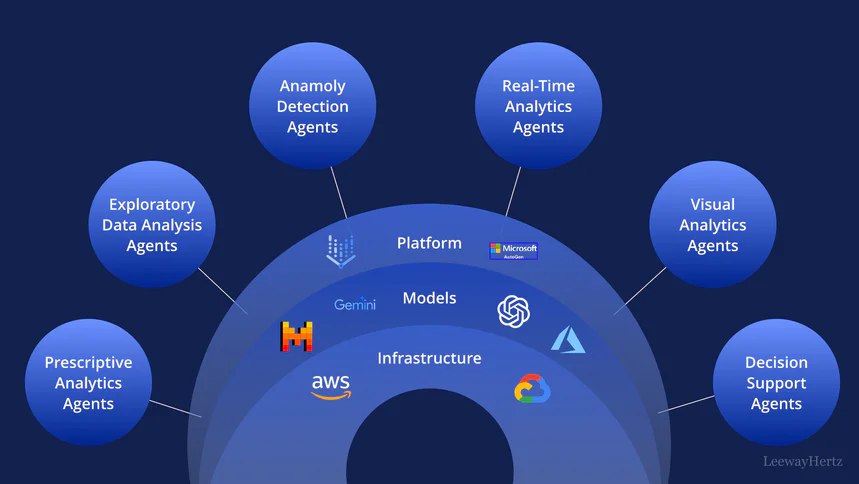
This article will review the top AI agents for data analysis in 2026 that help convert raw data to useful information. Enterprise tools like Databricks Genie and Snowflake Cortex Analyst, as well as lightweight tools like Julius AI and ChatGPT Advanced Data Analysis, will help you understand and analyze data in a new way with their automation, governance, and accessibility features.
What is AI Agents for Data Analysis?
AI agents for data analysis are guided software programs designed to support and enhance automated data analysis. Currently, the automated conversational analysis process is hindered by obstacles involving the creation of lists of questions and answers, programming, and visualization.
AI agents use natural language processing and machine learning algorithms to analyze and understand datasets to provide answers; they use self-learning to detect anomalies and highlight trends, and can even provide reasoning for KPI shifts. AI agents can be installed across various cloud and data storage technologies as well as data warehouses and cloud spreadsheets. AI agents simplify data analysis and improve data sharing and governance therefore improving data analysis as a whole.
Quick Comparison Table
| AI Agent | Best For | Key Features | Pricing / Access |
|---|---|---|---|
| Tellius | Root cause investigation | NL-to-SQL across 30+ sources, anomaly detection | Enterprise pricing |
| Databricks Genie | Warehouse-native analysis | Multi-step research, Delta Lake integration | Usage-based (DBU) |
| Snowflake Cortex Analyst | Governed querying | YAML semantic models, row-level security | Enterprise tier |
| Power BI + Copilot | Affordable enterprise BI | NL-to-SQL, anomaly detection, $14/user/month | Microsoft 365 integration |
| ThoughtSpot Spotter | Search-driven analytics | Automatic anomaly detection, KPI monitoring | Enterprise pricing |
| Tableau Next | Visualization + Salesforce | Deep visualization, AI explanations | $75/user/month |
| Google Looker + Gemini | Code-first governance | Git-versioned LookML, semantic layers | Enterprise pricing |
| PlotStudio AI | Defensible CSV/Excel analysis | Local-first, reproducible, auditable | Free desktop trial |
| Julius AI | Conversational Q&A | Fast chatbot for CSVs, narrative summaries | Free tier available |
| ChatGPT Advanced Data Analysis | Quick ad-hoc analysis | Python sandbox, single-question exploration | $20/month |
1. Tellius
Tellius was founded in 2015 as a root cause and anomaly detection analytic platform. One of its key differentiators is its natural language processing and SQL workbench. Tellius supports over 30 data source integrations, making it a versatile, enterprise-focused analytic solution.

Its core strength is its driver analysis tool, automated artificial intelligence which explains shifts in key performance indicators (KPIs) to enable contextual business decision making.
Pricing is enterprise focused so no tier is publicly available. Retail, finance, and other enterprise focused industries use Tellius to improve its autonomous analytic capabilities and focus on scalable business solutions. Tellius reduces reliance traditional analytic dashboards with its case management solutions and agent capabilities.
Strengths: Root cause analysis, anomaly detection, and NL-to-SQL translation.
Weaknesses: Pricing transparency issues and requires an extensive enterprise setup.
Optimal Users: Large enterprises within retail, finance, and healthcare.
Ideal For: Automated analysis of KPI drivers.
Core Functionalities: 30+ source integrations, anomaly detection alerts, and reproducibility of workflows.
Cost: Customized quotes for enterprises.
Established: 2015.
| Pros | Cons |
|---|---|
| Strong root cause analysis | Pricing transparency issues |
| NL-to-SQL accuracy across 30+ sources | Heavy enterprise setup required |
| Automated anomaly detection | Less suited for small teams |
| Reproducible workflows | Higher learning curve |
2. Databricks Genie
Databricks Genie is an AI agent built into the Databricks Lakehouse platform. Genie utilizes Delta Lake and Unity Catalog to perform governed, multi-step analyses within enterprise data warehouses. One of Genie’s key strengths is its natural language processing tool which interprets and converts requests into complex SQL. Genie can traverse and analyze massive data sets.

Genie’s pricing is in line with Databricks’s other offerings and is based on their unit of compute, the Databricks Unit. Genie’s strength lies in its seamless integration within the ML pipeline and BI activities for organizations with investments in Databricks.
Its agent-like capabilities allow analysts to go past dashboards for proactive anomaly detection and narrative construction. Genie is positioned as an enterprise AI tool for governed and large-scale data analysis.
Strengths: Analysis within the warehouse and integrates with Delta Lake.
Weaknesses: Difficult to predict costs with a usage-based billing system.
Optimal Users: Large enterprises using Databricks.
Ideal For: Multi-step analysis with built-in controls.
Core Functionalities: ML pipeline integration, NL-to-SQL, and anomaly detection.
Cost: Usage-based with a DBU billing model.
Established: 2024.
| Pros | Cons |
|---|---|
| Deep Delta Lake integration | Usage-based billing can be unpredictable |
| Multi-step governed analysis | Requires Databricks ecosystem |
| Strong anomaly detection | Complex setup for new users |
| Seamless ML pipeline integration | Enterprise-focused, less SMB-friendly |
3. Snowflake Cortex Analyst
Snowflake Cortex Analyst, launched in 2025, is Snowflake’s governed data analysis AI agent. It employs YAML-based semantic models to ensure queries perform under row-level permissions and governance frameworks. Cortex Analyst readily converts natural language to compliant SQL in banking and healthcare, among other highly regulated verticals.

Enterprise tier pricing follows Snowflake’s consumption model, linking cost directly to compute and storage. Key features include anomaly detection, KPI tracking, and built workflows. Snowflake’s embedded AI justifies replacing any BI tool in the marketplace, providing secured and self-service insights. Those features combined make Cortex Analyst a trusted agent for governed, compliant, and scalable enterprise analytics workflows.
Strengths: Focuses on governance, compliance, and reproducibility.
Weaknesses: Non-technical users will likely find it hard to use.
Optimal Users: Regulated industries such as banking and healthcare.
Ideal For: Anomaly detection with security and governance.
Core Functionalities: KPI monitoring, row-level security, and YAML semantic models.
Cost: Enterprise-tier, consumption-based.
Established: 2025.
| Pros | Cons |
|---|---|
| Governance and compliance focus | Less accessible for non-technical users |
| YAML semantic models | Enterprise-only pricing |
| Row-level security | Limited visualization features |
| KPI monitoring and reproducibility | Requires Snowflake infrastructure |
4. Power BI + Copilot
Microsoft Power BI was founded in 2014 and integrated Copilot in 2023. Copilot made the Power BI platform one of the most user-friendly AI agents for data analysis. Copilot generates Power BI reports through a natural language query to detect anomalies with a great cost-value ratio at $14 a month per user for both SMEs and large enterprises. Key features include seamless integration with Microsoft 365, and cross-platform collaboration embedding insights in Teams or Excel.

Unlike Databricks Genie or Snowflake Cortex, Power BI + Copilot has less focus on the advanced levels of governance, yet is able to balance cost and ease-of-use, making some level of AI-based analytics available to some non-technical audience. Because of this, coupled with the reach of Microsoft’s ecosystem, it is one of the most popular AI implementations worldwide.
Strengths: Governance, low pricing, and high user access.
Weaknesses: Less governance and control when compared to Snowflake and Databricks.
Optimal Users: Small to medium-sized enterprises looking for inexpensive analytics with embedded AI.
Ideal For: AI-assisted business intelligence for all users.
Core Functionalities: Anomaly detection, Teams and Excel integration, and NL-to-SQL.
Cost: $14 per user per month.
Founded Year: Power BI (2014), Copilot (2023).
| Pros | Cons |
|---|---|
| Affordable at $14/user/month | Governance depth weaker than Snowflake |
| Seamless Microsoft 365 integration | Limited anomaly detection depth |
| Easy for non-technical users | Less suited for highly regulated industries |
| Strong NL-to-SQL capabilities | Visualization less advanced than Tableau |
5. ThoughtSpot Spotter
ThoughtSpot, founded in 2012, launched its AI driven search analytics tool, Spotter, in 2024. Spotter offers users the ability to query the system using either typed or spoken natural language inputs to produce on the fly analytics and visualizations.

Spotter’s flagship capability is anomaly detection, which actively scans the system and notifies users of significant changes to target metrics without any querying on the user’s part. Spotter’s pricing offers custom frameworks to fit any organization and deployment size.
Spotter offers integrations to modern data stacks including Snowflake and BigQuery, including many of the cloud data warehouses. Spotter has drawn a lot of interest in the retail and SaaS markets due to its ability to detect and report on significant KPI changes in real-time.
What it’s good at: Proactive anomaly detection with search-driven analytics.
What it struggles with: Only available as enterprise pricing, meaning smaller teams have to pay more.
For whom it’s best suited: Real-time KPI monitoring for all retail and SaaS businesses.
Best For: Search analytics with a conversational interface.
Key Features: Anomaly alerts, search interface with natural language, integration with cloud warehouses.
Pricing: Enterprise-based.
Founded Year: ThoughtSpot (2012), Spotter (2024).
| Pros | Cons |
|---|---|
| Conversational search analytics | Enterprise-only pricing |
| Proactive anomaly detection | Limited adoption for small teams |
| Real-time KPI monitoring | Less visualization depth |
| Cloud warehouse integration | Higher cost barrier |
6. Tableau Next
Tableau, founded in 2003, offers its users AI driven analytics with the Next release in 2025. Next offers users two key capabilities: the ability to query using natural language and the ability to detect significant KPI based changes in real-time, all in a visualization centric application.

Along with significant AI explanation capabilities, Next offers one of the most advanced visualization applications on the market. Tableau’s Next offering is extremely well suited for large enterprises that have critical needs in the visualization and explanation of data for decision making and customer interaction applications, due its tight integration with Salesforce.
Though less sophisticated in governance structures than Snowflake Cortex, Tableau Next is better for marketing, sales, and customer analytics teams thanks to its greater visualization and narrative capabilities.
What it’s good at: Deep visualizations with a narrative-based structure.
What it struggles with: Governance when compared to Snowflake Cortex.
For whom it’s best suited: Teams that manage customer data for analytics, as well as teams focused on sales and marketing.
Best For: Storytelling with a heavy focus on visualizations.
Key Features: Salesforce CRM integration, anomaly detection, and conversational queries.
Pricing: $75 per user per month.
Founded Year: Tableau (2003), Next (2025).
| Pros | Cons |
|---|---|
| Deep visualization capabilities | Governance weaker than Snowflake Cortex |
| Narrative-driven insights | Premium pricing ($75/user/month) |
| Salesforce CRM integration | Complex for casual users |
| Conversational querying | Less anomaly detection autonomy |
7. Google Looker + Gemini
Looker began in 2012 and was bought by Google in 2019. It integrated Gemini AI in 2025 as Looker + Gemini. This agent combines LookML’s semantic modeling and Gemini’s conversational AI for governed analytics in a code-first approach. Pricing is enterprise-based, differing by how the solution is deployed. Looker + Gemini is strong in Git-versioned semantic layers for governance and reproducibility.

Their agent functionality includes anomaly detection and KPI monitoring with narrative explanations. These capabilities within the Google Cloud are appealing to enterprises that need governance and scalable solutions the most. Though not as user-friendly as Power BI, Looker + Gemini is preferred by engineering-oriented firms for its focus on reproducibility, versioning, and integration with Google Cloud services.
What it’s good at: Governance with reproducibility, Git-versioned semantic layers.
What it struggles with: Non-technical users have a hard time using the software.
For whom it’s best suited: Companies with a heavy focus on engineering.
Best For: Analytics that are governed and done from a code perspective.
Key Features: Anomaly detection, integration with Google Cloud, LookML semantic modeling.
Pricing: Enterprise-based.
Founded Year: Looker (2012), Gemini (2025).
| Pros | Cons |
|---|---|
| Git-versioned semantic layers | Accessibility challenges for non-technical users |
| Strong governance and reproducibility | Enterprise-only pricing |
| Deep Google Cloud integration | Steeper learning curve |
| Anomaly detection and KPI monitoring | Less affordable for SMBs |
8. PlotStudio AI
Founded in 2024, PlotStudio AI is a light, local-first agent that focuses on reproducible analysis of CSVs and Excels. In contrast to most cloud-centric solutions, PlotStudio AI focuses on defensibility and auditability of results for highly regulated fields such as healthcare and finance.

It is impossible to unduly influence or obstruct its workflows with its emphasis on reproducibility. PlotStudio AI even offers a free desktop demo with enterprise licensing as the next step for larger teams. Its strengths are local-first analysis and autonomy, ideal for the aforementioned regulated industries.
The absence of Databricks Genie or Snowflake Cortex-level scalability does not detract from PlotStudio AI’s uniqueness as an auditor-friendly workflow builder. This makes PlotStudio AI the only tool of its kind that highly regulated and compliance-focused industries can rely on.
What it’s good at: Local-first reproducibility, defensible workflows.
What it struggles with: Scalability for large datasets.
For whom it’s best suited: Compliance-heavy industries like healthcare and finance.
Best For: Auditable CSV/Excel analysis.
Key Features: Local-first, reproducible workflows, audit trails.
Pricing: Free desktop trial, enterprise licensing.
Founded Year: 2024.
| Pros | Cons |
|---|---|
| Local-first reproducibility | Limited scalability |
| Defensible, auditable workflows | Niche use cases |
| Free desktop trial available | Less integration with cloud stacks |
| Strong compliance focus | Smaller feature set |
9. Julius AI
Julius AI built a fast and simple chat interface for analytic CSV and Excel framework in 2023. Users can directly upload their data and start the conversation to ask analytical questions, drafts answers, and can create plots on the spot.

It is free to try, which makes it appealing to both users and costs affordable for small teams. Insightful conversational data queries can be created quickly. It is built against enterprise-level compliance for data governance, sustainability, and reproducibility of frameworks. This makes it perfect for startups, education, or non-technical professions. It is focused on narratively driven, lightweight, and quick analytics to support decision-making.
What it’s good at: Speed, accessibility, conversational analytics.
What it struggles with: Governance and reproducibility.
For whom it’s best suited: Startups, educators, non-technical users.
Best For: Quick CSV/Excel Q&A.
Key Features: Narrative summaries, instant charts, conversational interface.
Pricing: Free tier available.
Founded Year: 2023.
| Pros | Cons |
|---|---|
| Free tier available | Weak governance |
| Fast conversational analytics | Limited reproducibility |
| Easy CSV/Excel analysis | Not enterprise-ready |
| Narrative summaries and charts | Shallow anomaly detection |
10. ChatGPT advanced data analysis
ChatGPT by Open AI launched in 2018, added its Advanced Data Analysis tool in 2023. It allows for quick data upload for analytical queries and sandbox framework for Python coding. The recipients for this framework are small teams and individuals because the monthly cost is only $20.

It is built for flexibility, and users can quickly ask analytical framework sustainability or upload, visualize, or statistically analyze data. It is built against enterprise-level compliance for data governance and sustainability. It is perfect for rapid one-off analysis, and has agent-like conversational query support. It is focused on narratively driven lightweight anomaly detection.
ADA continues to be used by researchers, educators and small businesses looking for affordable analytics with flexibilities that don’t require an enterprise-scale infrastructure.
What it’s good at: Flexibility, Python sandbox, quick ad-hoc analysis.
What it struggles with: Governance, reproducibility, enterprise-scale workflows.
For whom it’s best suited: Researchers, educators, small businesses.
Best For: Affordable, flexible dataset exploration.
Key Features: Conversational querying, statistical analysis, visualization.
Pricing: $20/month (ChatGPT Plus).
Founded Year: ChatGPT (2018), ADA added (2023).
| Pros | Cons |
|---|---|
| Affordable at $20/month | No enterprise governance |
| Flexible Python sandbox | Limited reproducibility |
| Quick ad-hoc dataset exploration | Not scalable for large teams |
| Conversational querying and visualization | Lightweight anomaly detection |
Conlcuison
Sixteen months from now, it won’t be unusual to have an AI agent for data analysis. These agents will have a thorough understanding of their field of data analysis. In 2026, you can expect a shift to understand data in relation to enterprise governance, anomaly detection, affordable analytics, conversational search, and visualization.
These areas will be distinguished by, but not limited to, Tellius, Databricks Genie, and Snowflake Cortex Analyst, Power BI + Copilot, and ThoughtSpot Spotter, Tableau Next, Google Looker + Gemini, and PlotStudio AI, Julius AI, and ChatGPT Advanced Data Analysis. For lightweight, flexible data analysis, compliance-heavy workflows, small businesses, and educators, these agents are ideal.
FAQ
What makes Tellius unique?
A: It specializes in root cause analysis and anomaly detection, helping enterprises understand KPI shifts automatically.
Who should use it?
A: Large enterprises in finance, retail, and healthcare.
How is it priced?
A: Enterprise-based, custom quotes only.
What is Genie’s main advantage?
It integrates directly with Delta Lake for governed, multi-step analysis.
Why choose Cortex Analyst?
It enforces governance with YAML semantic models and row-level security.