
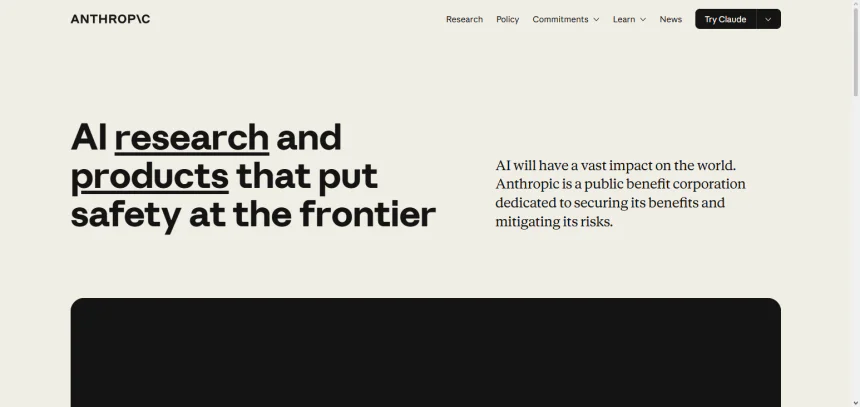
This article will cover Anthropic AI Agents, cutting-edge AI technology focused on developing intelligent services that are smarter, safer, and more aligned with humans.
Here, we will analyze Anthropic AI Agents functionality, basic components, Auclade models, use cases, pros and cons, and likely developments. This article will describe the relevance of these AI agents in optimizing automation, productivity, and the future of rational decision-making.
What Is Anthropic AI Agents?
Anthropic AI Agents are AI systems that tackle demanding tasks involving reasoning, planning, and autonomy. Fleeting input is not necessary for each step. Based on Anthropic’s Claude AI models, these systems help users achieve their goals by deciphering complex information, interacting with external systems and resources, and executing elaborate workflows.

Unlike ordinary chatbots, Anthropic AI Agents exhibit active problem-solving and task automation skills. They are suitable for a variety of applications, including but not limited to, research, coding, and business and customer service operations.
Of main priority to Anthropic is fortifying their design and safety principles to guarantee that AI products are secure, trustworthy, and truly aligned with human values.
How to Get Started with Anthropic AI (Step-by-Step)
Step 1: Sign Up for Anthropic
- Sign up on the official Anthropic website and create your user account with your email address.
- After registering, you will gain access to the tools and features of Claude AI.

Step 2: Select a Claude AI Model
- Select among the Claude AI models depending on your requirements:
- Claude Opus: Excellent for advanced reasoning and more complex tasks.
- Claude Sonnet: Good for most professional tasks with reasonable efficiency.
- Claude Haiku: Quick and efficient for straightforward tasks.
Step 3: Get Access to Claude AI
- Access Claude via the web interface or the Anthropic API platform.
- Ask Claude your questions, provide instructions, or define a work-related task.
Step 4: State Your Task or Objective
- State what you need the AI agent to do.
- Include the instructions, relevant context, and description of the task’s outcome you desire.
Step 5: Add Tools and Information
- Merge Anthropic AI with apps, APIs, databases, or other tools integral to your business.
- Let the agents pull the information they need to complete the automated task.
Step 6: Design AI Agent Task Flows
- Design sequential task flows where the AI agent can analyze information and make decisions to complete a set of tasks.
- Define the behavior of the agent using available APIs and developer tools.
Step 7: Evaluate and Optimize
- Analyze both the responses from the AI and the outcomes of the tasks.
- Modify the instructions and task flows to achieve the most efficient results.
Step 8: Implement Anthropic AI for Various Scenarios
- Incorporate Anthropic AI Agents for coding help, research, customer support, content writing, data analysis, and automation of business processes.
Step 9: Watch for Safety and Alignment
- Make sure AI results comply with business rules, security demands, and ethical norms.
- Keep an eye on AI for critical choices.
Step 10: Widen AI Agent Applications
- Widen AI use for all teams and departments by embedding additional tools, enhancing workflow integration, and refining overall performance.
How Do Anthropic AI Agents Work?
Understanding User Goals
- The first step for Anthropic AI Agents is to analyze user input instructions. This is how they determine users’ goals, needs, and desired outcomes.
- The agents then determine the main task and the preferred approach to complete the task.
Analyze Information via Claude Models
- Anthropic AI Agents employ Claude’s language models to analyze context and logic to formulate and articulate the best answer.
- The agents have the ability to analyze and comprehend large volumes of data.
3. Decompose Tasks
- Anthropic AI Agents have the ability to decompose larger requests into more manageable tasks and sub-goals.
- The agents’ ability to decompose requests is one unique way to help achieve their goals.
Employ Logic and Discretion
- Agents have the ability to analyze and compare the information and make the best choice among several alternatives.
- The agents’ discretion is especially useful in analysis and research.
Integrate with External Systems
- Anthropic AI Agents have the ability to integrate with APIs, databases, tools, and business applications.
- Integration with tools allows the agents to go beyond simple dialogue to perform the needed tasks.
Perform Complex Tasks
- The agents have the ability to perform business tasks, coding, data analysis, and even report generation.
- They aid users by performing the repetitive tasks that are needed.
Remember Client Information
- Anthropic AI Agents have the ability to remember specific information about a client during their session.
- The agents are able to modify their responses to client goals based on the context of their previous interactions.
Benefits of Using Anthropic AI Agents
Human Alignment – Thanks to Anthropic’s Constitutional AI, Outputs are humans and ethically aligned.
Enhance Trust – Agents are made safer and resistant to contempt.
Autonomous Workflows – Very little human supervision is needed due to the agents’ ability to plan, execute and make real time changes to the multi-step tasks.
Productivity Boost – Time and resources are saved from the enterprise automation research, coding, customer support and other business activities.
Transparency – Decision-making and reasoning are reflected in the outputs.
Scalable Safety – Agents are made with safety in mind and designed particularly to diminish the likelihood of harmful outputs across the various use cases.
Enterprise Integration – With tools like Claude Code and Claude Cowork, adoption is taking place across BFSI, tech and consumer services.
Future-Ready – Agents are positioned to determine the future of AI governance in the responsible use of AI across the verticals.
Key Features of Anthropic AI Agents
| Feature | Description |
|---|---|
| Advanced Reasoning | Uses Claude models to analyze complex problems and provide intelligent solutions. |
| Human-Aligned Intelligence | Designed to follow human intentions, ethical guidelines, and safety principles. |
| Autonomous Task Execution | Completes multi-step workflows with minimal human intervention. |
| Tool Integration | Connects with APIs, databases, and external applications to perform actions. |
| Context Understanding | Maintains conversation context to deliver more accurate and relevant responses. |
| Planning Capabilities | Breaks large tasks into smaller steps and creates effective execution strategies. |
| Data Analysis | Processes large amounts of information to generate insights and summaries. |
| Code Assistance | Helps developers write, review, debug, and optimize software code. |
| Safety Controls | Uses responsible AI techniques to reduce harmful or unreliable outputs. |
| Scalable Automation | Supports businesses in automating workflows across different industries. |
| Natural Language Interaction | Allows users to communicate with AI using simple conversational instructions. |
| Continuous Improvement | Learns from feedback and interactions to improve task performance over time. |
Pricing Breakdown

| Plan | Features | Monthly Price (Global) | Monthly Price (India) | Best For |
|---|---|---|---|---|
| Free | Basic Claude chat, limited usage, web/iOS/Android access | $0 | Free | Casual users |
| Pro | Claude Code, Cowork, Design, Science, unlimited projects, research mode | $20 ($17 annual) | ₹1,999 (annual) / ₹2,399 (monthly) | Professionals, daily productivity |
| Max 5x | 5× Pro usage, higher output limits, priority access, early features | From $100 | ₹11,999 | Power users needing extended sessions |
| Max 20x | 20× Pro usage, maximum limits, enterprise‑grade priority | From $100+ | ₹23,999 | Heavy enterprise workloads |
| Team Standard | Shared projects, admin controls, SSO, centralized billing | $ per seat | ₹2,399/user (annual) / ₹2,999/user (monthly) | Small–mid teams |
| Team Premium | Advanced admin tools, compliance, extended context window | Custom | ₹11,999–₹14,999/user | Enterprises needing compliance |
| API Usage | Metered per‑token billing: Opus $5 input/$25 output per million tokens; Sonnet $3/$15; Haiku $1/$5 | Variable | Variable | Developers, startups |
Claude Models Powering Anthropic AI Agents
Claude is a family of sophisticated AI models developed by Anthropic that are designed to reason, understand language, and execute tasks in a safe manner.
Claude models are at the core of Anthropic’s agent systems, which allows them to understand, analyze, and generate solutions to various tasks, including content and code generation, and the execution of workflows of arbitrary complexity.
Claude models can be optimized for different dimensions, such as the ability to reason with high latency and cost, or models which can execute lightweight tasks at a fraction of the cost.
Claude Opus is the best model at complex reasoning, and analysis and retrieval; Claude Sonnet offers the best tradeoff of latency and cost; and Claude Haiku targets low-latency, low-cost AI interactions. All of these models combined make Anthropic AI Agents systems reliable and safe.
Pros and Cons
| Pros | Cons |
|---|---|
| Advanced reasoning capabilities for complex tasks | May produce inaccurate or incomplete information sometimes |
| Strong focus on AI safety and human alignment | Requires human supervision for critical decisions |
| Handles multi-step workflows efficiently | Advanced features may require technical knowledge |
| Provides high-quality text analysis and generation | Can have limitations with real-time information access |
| Supports coding, research, and business automation | Integration with external tools may require development effort |
| Maintains strong context understanding during conversations | Higher usage costs for advanced models |
| Designed to reduce harmful and biased AI outputs | Performance depends on the quality of user instructions |
| Helps improve productivity and reduce repetitive work | Privacy concerns may arise when handling sensitive data |
| Offers different Claude models for various workloads | Not a complete replacement for human expertise |
| Enables scalable AI solutions for enterprises | Requires continuous monitoring and optimization |
Human Alignment in Anthropic AI Agents

Anthropic AI Agents center around human alignment. This includes designing AI systems to reflect human values, intentions, and safety regarding AI. Anthropic leverages methods, particularly, Constitutional AI, to develop Claude models that respond helpfully, truthfully, and harmlessly.
In alignment with user objectives, AI agents also steer clear of unsafe behaviors and are equipped to make safe, intentionally autonomous decisions. In support of their values, Anthropic concentrates on the transparency, reliability, and responsible behavior of its systems.
Their goal is to develop AI systems that work cooperatively with people and allow for the safe and trust-based adoption of AI technologies with a minimized threat of fully autonomous, decision-making AI systems.
Applications of Anthropic AI Agents
Customer Support – Safe and reliable customer support via chatbot/help desk response alignment.
Enterprise Automation – Document, schedule, and compliance task automation.
Coding Assistance – Safe code debugging, generation, and optimization via Claude Code.
Research & Knowledge – Data and insight synthesis for research and complex data.
Creative Workflows – Design and writing support and brainstorming.
Decision Support – Transparent reasoning for business, legal, or policy decisions.
Education & Training – Safe and interpretable tutoring and studying aid.
Healthcare Knowledge – Literature synthesis aid for non-diagnostic, research-based medical assistance.
Governance & Compliance – Regulatory, ethical, and safety standard assistance.
How Anthropic AI Agents Differ From Traditional AI Assistants
| Aspect | Anthropic AI Agents | Traditional AI Assistants |
|---|---|---|
| Core Philosophy | Built on Constitutional AI, prioritizing safety, ethics, and human alignment | Focused mainly on task completion and efficiency |
| Autonomy | Can plan, act, and adapt across multi‑step workflows | Typically reactive, responding only to direct prompts |
| Transparency | Provides interpretable reasoning and clear decision paths | Often opaque, with limited explanation of outputs |
| Safety | Resistant to jailbreaks, prompt‑injection, and harmful outputs | More vulnerable to misuse and adversarial prompts |
| Capabilities | Advanced coding, research synthesis, enterprise automation | Basic Q&A, reminders, simple task execution |
| Use Cases | Customer support, compliance, education, governance, creative workflows | Personal productivity, scheduling, casual queries |
| Enterprise Integration | Tools like Claude Code & Cowork tailored for professional environments | Limited enterprise‑grade features |
| Future Outlook | Positioned to shape AI governance and responsible adoption | Incremental improvements, less focus on ethics |
Supported Language
| Language | Support Level | Common Uses |
|---|---|---|
| English | Full Support | General conversations, coding, research, business tasks |
| Spanish | Strong Support | Translation, content creation, customer support |
| French | Strong Support | Communication, document analysis, writing assistance |
| German | Strong Support | Business workflows, research, and professional tasks |
| Italian | Strong Support | Text generation, translation, and analysis |
| Portuguese | Strong Support | Customer communication and content creation |
| Japanese | Strong Support | Business applications, translation, and AI interactions |
| Chinese (Simplified & Traditional) | Strong Support | Document processing and multilingual communication |
| Korean | Good Support | Content generation and professional assistance |
| Dutch | Good Support | Translation and productivity tasks |
| Arabic | Good Support | Multilingual conversations and text analysis |
| Hindi | Good Support | Content writing, translation, and general AI assistance |
| Other Languages | Varies | Support depends on language complexity and task requirements |
Anthropic AI Agents vs Other AI Agents
| Feature | Anthropic AI Agents | OpenAI AI Agents | Google AI Agents |
|---|---|---|---|
| Primary Focus | Safety, reliability, and human-aligned intelligence | General-purpose intelligence and advanced automation | Multimodal AI and ecosystem integration |
| Core AI Models | Claude models (Opus, Sonnet, Haiku) | GPT models | Gemini models |
| Main Strength | Deep reasoning and responsible AI behavior | Versatile problem-solving and broad capabilities | Strong search, data access, and multimodal performance |
| Human Alignment | Strong focus through Constitutional AI principles | Uses safety training and alignment methods | Focuses on responsible AI with Google safety frameworks |
| Reasoning Ability | Excellent for analysis, research, and complex tasks | Strong reasoning across multiple domains | Strong reasoning with multimodal understanding |
| Tool Integration | Supports APIs, tools, and external workflows | Extensive tools, plugins, and integrations | Deep integration with Google services |
| Coding Support | Advanced code analysis and developer assistance | Strong coding generation and debugging capabilities | Good coding support with development ecosystem connections |
| Business Applications | Enterprise automation, research, analysis, customer support | Productivity, automation, content creation, software development | Workspace automation, search, and enterprise solutions |
| Safety Approach | Safety-first design with emphasis on reducing harmful outputs | Balanced capability and safety approach | Focus on responsible and secure AI deployment |
| Best For | Organizations needing reliable and controlled AI systems | Users seeking flexible AI assistants and automation | Businesses using Google ecosystem tools |
| Limitations | May be less focused on some real-time applications | Requires careful prompting for best results | Benefits are strongest within Google services |
| Overall Advantage | Trustworthy, thoughtful, and human-centered AI agents | Powerful, flexible, and widely applicable AI agents | Connected, multimodal, and ecosystem-driven AI agents |
Challenges and Limitations of Anthropic AI Agents
AI Hallucination
- Even with rigorous logic and reasoning, Anthropic AI Agents may generate descriptions that can be factually incorrect or unsubstantiated.
Limited to No Access to Real-Time Information
- Agents won’t have access to real-time data unless they are explicitly integrated with live systems or other available online data.
Requires Human Control
- Most critical business and financial and even security decisions must always be controlled by a human operator.
Complicated Integration
- A considerable amount of expertise may be required to effectively connect AI agents to enterprise systems, APIs and databases.
More Expensive to Operate
- More advanced Claude models will utilize a considerable amount of computing resources, resulting in a higher cost of use.
Risk of Data Exposure
- Businesses need to be very cautious of sensitive data they may be exposing when they engage with AI tools.
Dependent on Good Prompts
- Good prompts and workflows are necessary to increase the odds of receiving a beneficial and accurate response.
Limited Understanding of Social Constructs
- AI agents can analyze text but may not have a developed understanding of human emotion or the social element of more complex situations.
Varying Performance by Language
- AI may have varying accuracy and the quality of responses may differ by the language being used and the complexity of the task.
Cannot Replace Human Experts
- Anthropic AI Agents will support professionals, but they will not be able to replace human creativity, judgment, and experience.
Who Should Use Anthropic AI Agents?
Anthropic AI Agents help businesses and professionals who need an AI that they can rely on to develop solutions that automate many tasks. These AI solutions can help companies implement better customer support services, and manage and analyze data to better their operations.
For developers, they provide support for automation and AI-assisted code generation and debugging, as well as application development. Researchers, analysts, and all users who need AI to help them process, summarize, and analyze data (especially at a deeper level) will benefit a lot from them.
Companies and organizations whose first priority is AI safety and transparency, and especially AI whose decisions are in alignment with humans, will greatly benefit from the availability of these AI Agents. These agents are also best for those users who need intelligent automation, with the added benefit of the control and security that come from the responsible use of AI.
Company Information
| Category | Details |
|---|---|
| Company Name | Anthropic PBC |
| Founded | 2021 |
| Headquarters | San Francisco, California, United States |
| Industry | Artificial Intelligence (AI) Research and Technology |
| Company Type | Public Benefit Corporation (PBC) |
| Founders | Dario Amodei, Daniela Amodei, and former OpenAI researchers |
| Main Product | Claude AI Models and AI Agent Technologies |
| Core Mission | To create reliable, interpretable, and safe AI systems that benefit humanity |
| Primary Focus | AI safety, alignment research, large language models, and responsible AI development |
| Flagship AI Family | Claude (Claude Opus, Claude Sonnet, and Claude Haiku) |
| Key Technology | Constitutional AI, large language models, AI reasoning systems, and agentic AI capabilities |
| AI Platform | Claude API and enterprise AI solutions |
| Target Users | Businesses, developers, researchers, enterprises, and professionals |
| Major Applications | AI assistants, coding, research, customer support, automation, document analysis, and productivity tools |
| Security Approach | Focuses on safe AI deployment, privacy protection, and reducing harmful AI behavior |
| Business Model | AI model access through subscriptions, API usage, and enterprise solutions |
| Major Partnerships | Works with technology companies and cloud providers to expand AI access |
| Notable Achievement | Developed Claude AI, one of the leading large language model platforms focused on safety and alignment |
| Competitors | OpenAI, Google DeepMind, Microsoft AI, Meta AI, and other AI research organizations |
| Website | Anthropic official platform and Claude AI services |
| Vision | Building powerful AI systems that are helpful, harmless, and aligned with human values |
Download Claude

Anthropic provides numerous ways to access Claude. There are Claude mobile apps for supported devices, Claude’s web app, and Anthropic’s official platforms.
With Claude’s app, mobile users can communicate with Anthropic’s AI. Claude can also be acquired via API. Developers and businesses can build custom AI solutions on top of Claude. Claude’s app plan determines its availability to users, features, and supported platforms.
Final Verdict
Anthropic AI agents are built upon Claude AI models and offer a significant advancement towards the creation of human-centered, safe, and trustworthy AI systems.
These agents bring a great deal of reasoning, automation, and a strong business, research, and development support. Because of their intentional development of safety and responsible AI practices, they are a major competitor in the trustworthy AI marketplace.
That said, the user still needs to assess the cost, the challenges of integration, and the continuous need for human supervision. Overall, Anthropic AI agents provide a great deal of intelligent safety that will help propel the AI safety mission.
FAQs
What are Anthropic AI Agents?
Anthropic AI Agents are advanced AI systems powered by Claude models that can understand tasks, reason, use tools, and complete multi-step workflows.
How do Anthropic AI Agents work?
They analyze user goals, plan actions, process information, use connected tools, and generate solutions while following safety guidelines.
What models power Anthropic AI Agents?
Anthropic AI Agents are powered by Claude models, including Claude Opus, Claude Sonnet, and Claude Haiku.
Are Anthropic AI Agents safe to use?
Yes, Anthropic focuses on AI safety and human alignment through approaches like Constitutional AI to reduce harmful outputs.
. Can Anthropic AI Agents write and analyze code?
Yes, they can assist developers with code generation, debugging, explanations, and software development tasks.